

Global Uncertainty Returns: Why Investors Need to be Careful in 2026
The year 2026 has reminded investors of an important truth:
Markets do not move only because of company profits and economic growth. They also react strongly to wars, geopolitical conflicts, crude oil prices, inflation, and investor sentiment.
The Iran–Israel conflict and subsequent US involvement created one of the biggest geopolitical uncertainties of recent years. Although ceasefire and diplomatic negotiations have reduced immediate fears, the situation remains fluid and investors cannot assume that risks have completely disappeared.
For India, the biggest concern is not the war itself but its impact on:
- Crude oil prices
- Inflation
- Rupee value
- Government finances
- Corporate earnings
- Stock market sentiment
Why Indian Investors Should Be Concerned
India imports a large share of its crude oil requirements. Whenever Middle East tensions increase:
- Oil prices usually rise.
- Transportation costs increase.
- Inflationary pressure rises.
- Corporate profit margins shrink.
- Equity market volatility increases.
Several market analysts have identified oil prices as the most important variable investors should watch during the current geopolitical situation.
Current Market Reality: Panic Is Not Required, But Caution Is
Recent developments indicate progress toward a US-Iran settlement and easing tensions, resulting in softer oil prices and some recovery in market sentiment. However, experts continue to warn that geopolitical headlines can trigger sudden volatility at any time.
Therefore:
Do Not Panic
But also:
Do Not Assume Risk Has Disappeared
The correct approach is disciplined investing combined with prudent risk management.
Investments That Should Be Restricted Right Now
This is perhaps the most important section for your readers.
1. Restrict Speculative Small-Cap and Penny Stock Investing
Many retail investors enter small-cap stocks after seeing stories of:
- 5x returns
- Multibagger gains
- Social media recommendations
During geopolitical uncertainty:
- Small caps generally fall more sharply.
- Liquidity dries up quickly.
- Recovery takes longer.
Avoid
❌ Penny stocks
❌ Telegram stock tips
❌ WhatsApp market recommendations
❌ Unknown small companies with weak earnings
Prefer
✔ Large-cap companies
✔ Index funds
✔ Flexi-cap mutual funds
✔ Established businesses with strong cash flow
2. Restrict Sector-Specific Betting
Many investors are currently chasing:
- Defence stocks
- Oil stocks
- Shipping stocks
- Energy stocks
because of war-related headlines.
This approach is dangerous.
Wars create uncertainty and price spikes, but these sectors can reverse sharply when geopolitical conditions change.
Avoid
❌ Putting 30-50% of portfolio into one sector
❌ Investing based on news channels
❌ Chasing recent winners
3. Restrict Cryptocurrency Exposure
Global uncertainty often causes extreme swings in cryptocurrencies.
Bitcoin and other digital assets remain highly volatile and can move sharply based on risk sentiment and global events. Market commentators have noted that geopolitical tensions have affected broader investor risk appetite across asset classes.
Suitable Only For
- High-risk investors
- Young investors with surplus money
Not Suitable For
- Pensioners
- Retirees
- Conservative investors
- Emergency savings
4. Restrict Leveraged Trading
The most dangerous investment activity today is borrowing money to invest.
Avoid:
❌ Futures & Options (F&O) speculation
❌ Margin trading
❌ Personal loans for investing
❌ Credit-card-funded investments
In volatile markets, leverage multiplies losses faster than gains.
5. Restrict Lump Sum Equity Investments
Investing a large amount at one time may not be wise when markets are reacting to geopolitical headlines.
Better Alternative
Use:
- SIP
- STP (Systematic Transfer Plan)
- Phased investing
This reduces timing risk.
6. Restrict Investments in Unregulated Products
Investors should stay away from:
❌ Guaranteed 20-30% return schemes
❌ Unregulated forex trading
❌ Overseas trading schemes promising extraordinary returns
❌ Social media investment influencers selling “secret strategies”
Whenever uncertainty rises, frauds increase.
Investments That Should Be Increased
Instead of focusing only on what to avoid, investors should know where safety lies.
1. Emergency Fund
Maintain at least:
Working Individuals
6-12 months expenses
Pensioners
12-24 months expenses
Prefer:
- Savings account
- Fixed Deposits
- Sweep accounts
2. Quality Fixed Deposits
FDs become attractive during uncertain periods because they offer:
- Capital safety
- Predictable returns
- Liquidity
They may not create extraordinary wealth but provide stability.
3. Diversified Mutual Funds
Continue SIPs in:
- Index Funds
- Large Cap Funds
- Flexi Cap Funds
Market corrections often create future wealth-building opportunities. Experts continue to note that geopolitical events usually create short-term volatility more than permanent market damage.
4. Gold Allocation
Gold has historically acted as a hedge during:
- Wars
- Inflation
- Currency uncertainty
- Geopolitical crises
Recent periods of Middle East tension have supported demand for gold as a safe-haven asset.
Suggested Allocation
5%–15%
Avoid excessive concentration even in gold.
Special Advice for Government Employees
Government employees have:
- Stable salary
- Pension-related benefits
- Lower income uncertainty
Therefore they should:
Continue SIPs
Do not stop retirement investments because of temporary headlines.
Avoid Market Timing
Nobody can accurately predict:
- War outcomes
- Oil prices
- Market bottoms
Maintain Asset Allocation
A practical model:
| Asset Class | Allocation |
|---|---|
| FD & Emergency Fund | 20% |
| Equity Mutual Funds | 60% |
| Gold | 10% |
| Debt/Other Assets | 10% |
Special Advice for Pensioners
Pensioners should prioritize:
Capital Protection
Before wealth maximization.
Suggested approach:
| Asset Class | Allocation |
|---|---|
| FD / SCSS / Safe Instruments | 60-80% |
| Mutual Funds | 15-30% |
| Gold | 5-10% |
Avoid chasing returns.
Remember:
A retiree’s biggest objective is not becoming rich. It is ensuring that money never runs out.
Warning Signs Every Investor Should Watch
Immediately become defensive if:
- Crude oil sustains above critical levels for several weeks.
- Inflation rises significantly.
- Major shipping routes face disruption.
- Global central banks become more aggressive on interest rates.
- Corporate earnings begin weakening.
Oil prices remain the key transmission mechanism through which Middle East conflicts can affect India and global markets.
Final Verdict: What Should Investors Do Now?
The current Iran–Israel–US situation is not a reason to abandon investing.
However, it is a strong reminder that:
Restrict
❌ Penny stocks
❌ Small-cap speculation
❌ F&O trading
❌ Borrowed-money investing
❌ Excessive crypto exposure
❌ Sector betting
❌ Social-media-driven investments
Continue
✔ SIPs in diversified mutual funds
✔ Fixed Deposits for safety
✔ Emergency fund creation
✔ Gold allocation for diversification
✔ Long-term retirement investing
Golden Rule for 2026
“This is not the time to chase extraordinary returns. It is the time to protect capital, stay diversified, and allow disciplined investing to work over the long term.”
History shows that wars, oil shocks, and geopolitical crises create volatility. Investors who remain diversified, avoid speculation, and stay focused on long-term goals are usually the ones who emerge stronger when uncertainty eventually fades.
- Retirement के बाद Pension के साथ Extra Monthly Income कैसे बनाएं? ESM & Pensioners के लिए SWP की पूरी जानकारी
 Retirement Planning for Ex-Servicemen & Pensioners | SIP vs SWP |… Read more: Retirement के बाद Pension के साथ Extra Monthly Income कैसे बनाएं? ESM & Pensioners के लिए SWP की पूरी जानकारी
 - CKYC Digital ID कैसे Download करें ? Full Step-by-Step Guide 2026
 Introduction आजकल Bank Account, Mutual Fund, Insurance, Demat Account या किसी… Read more: CKYC Digital ID कैसे Download करें ? Full Step-by-Step Guide 2026
 - Senior Citizens Savings Scheme (SCSS) in Post Office 2026: Complete Guide, Interest Rate, Eligibility, Tax Benefits & ₹30 Lakh Interest Calculation
 Senior Citizens Savings Scheme (SCSS): The Best Government Investment Scheme for… Read more: Senior Citizens Savings Scheme (SCSS) in Post Office 2026: Complete Guide, Interest Rate, Eligibility, Tax Benefits & ₹30 Lakh Interest Calculation
 - Fixed Deposit Interest Rates in India August 2026 : Which Bank Offers the Best Returns?
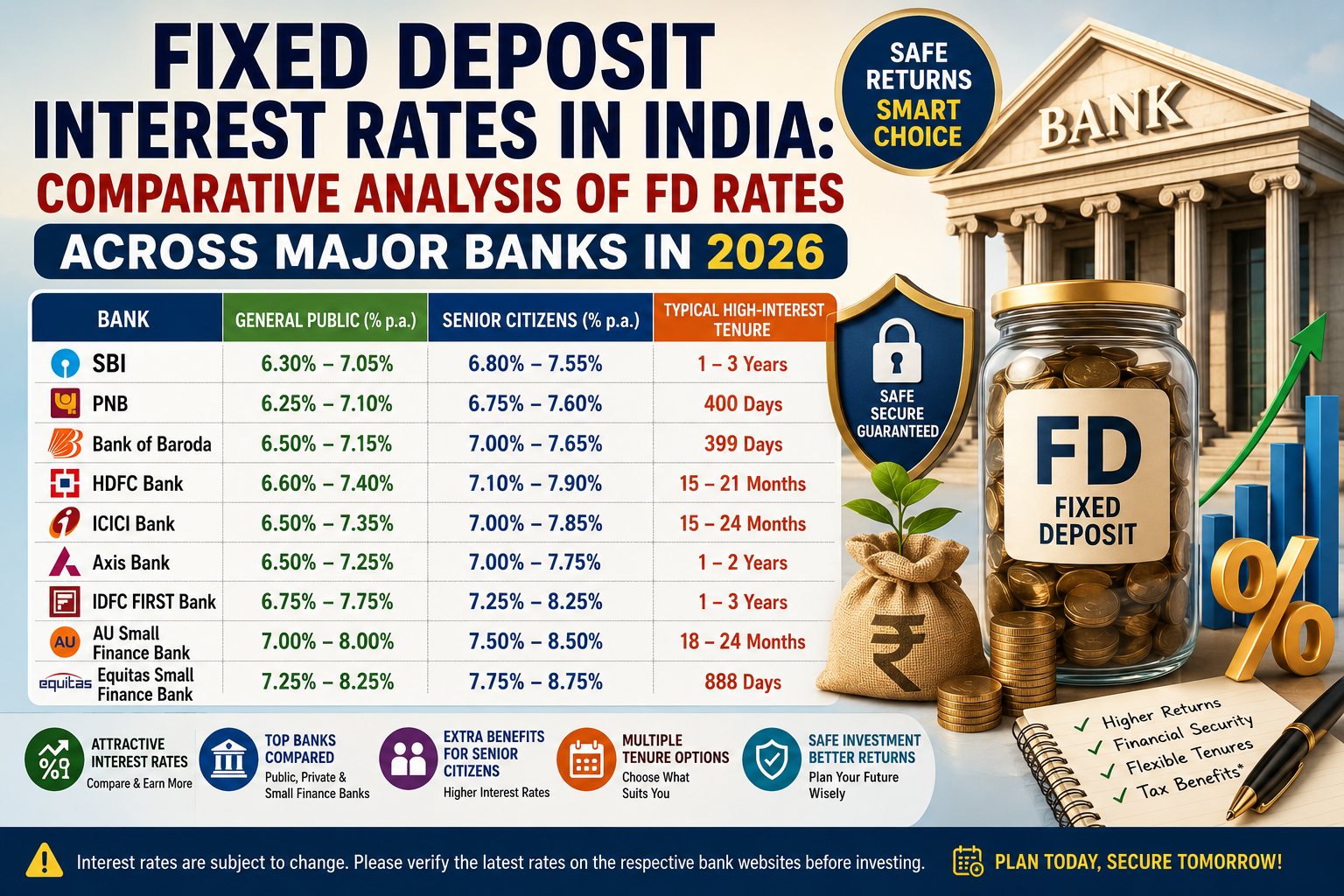 Fixed Deposits (FDs) continue to remain one of the most popular… Read more: Fixed Deposit Interest Rates in India August 2026 : Which Bank Offers the Best Returns?
 - How to Become Rich with Your Present Income : The Secret Guide to Smart Investing and Wealth Creation
 How to Become Rich with Your Potential and Present Income: Investing… Read more: How to Become Rich with Your Present Income : The Secret Guide to Smart Investing and Wealth Creation
 - The Master Guide to Systematic Withdrawal Plans (SWP): Build a Reliable Monthly Income from Mutual Funds
 Systematic Withdrawal Plans (SWPs) have become one of the most effective… Read more: The Master Guide to Systematic Withdrawal Plans (SWP): Build a Reliable Monthly Income from Mutual Funds
 - Post Office Small Savings Interest Revised Rates from 1 July 2026: Compare with Bank FD & other Investment Options
 The Government of India has retained the interest rates on all… Read more: Post Office Small Savings Interest Revised Rates from 1 July 2026: Compare with Bank FD & other Investment Options
 - 95% People Don’t Know This Government Investment That Offers High Returns and Maximum Safety – Complete Guide to India Post Savings Schemes 2026
 Looking for a completely safe investment that provides better returns than… Read more: 95% People Don’t Know This Government Investment That Offers High Returns and Maximum Safety – Complete Guide to India Post Savings Schemes 2026
 - Invest in Corporate Bonds with Up to 13.25% Returns: A Smart and safe Investment Option for Stable Income for Pensioners
 Invest in Corporate Bonds with Up to 13.25% Returns: Complete Guide… Read more: Invest in Corporate Bonds with Up to 13.25% Returns: A Smart and safe Investment Option for Stable Income for Pensioners
 - How to Invest Your ₹1 Crore Retirement Corpus Wisely in India (2026 Guide): The Complete Safe Investment Roadmap for Lifelong Monthly Income
 How to Invest Your ₹1 Crore Retirement Corpus Wisely Without Losing… Read more: How to Invest Your ₹1 Crore Retirement Corpus Wisely in India (2026 Guide): The Complete Safe Investment Roadmap for Lifelong Monthly Income
 - Senior Citizen Savings Scheme (SCSS) 2026: Complete Guide to Interest Rate, Eligibility, Tax Benefits, Withdrawal Rules & Smart Investment Strategy
 Senior Citizen Savings Scheme (SCSS) 2026: A Safe Investment for Regular… Read more: Senior Citizen Savings Scheme (SCSS) 2026: Complete Guide to Interest Rate, Eligibility, Tax Benefits, Withdrawal Rules & Smart Investment Strategy
 - Business Wisdom for Exservicemen and Fresher Beginners : Business Case Studies Every Entrepreneur Must Learn Before Starting a Business
 Introduction A large number of Ex-servicemen are intended to establish their… Read more: Business Wisdom for Exservicemen and Fresher Beginners : Business Case Studies Every Entrepreneur Must Learn Before Starting a Business
 - Top 11 Secure Investment Options for Senior Citizens & Exservicemen in 2026: A Complete Financial Guide for Safe Income & Wealth Protection
 Retirement is not just about stopping work—it’s about ensuring a financially… Read more: Top 11 Secure Investment Options for Senior Citizens & Exservicemen in 2026: A Complete Financial Guide for Safe Income & Wealth Protection
 - Warren Buffett’s 7 Golden Rules of Investing: The Ultimate Beginner-to-Advanced Roadmap for Safe Wealth Creation
 What are the kind of investors ? Every market cycle creates… Read more: Warren Buffett’s 7 Golden Rules of Investing: The Ultimate Beginner-to-Advanced Roadmap for Safe Wealth Creation
 - Best Investment Plan in 2026 for a Better Life: A Complete Guide to Building Wealth and Financial Security
 Money alone cannot guarantee happiness, but poor financial planning can certainly… Read more: Best Investment Plan in 2026 for a Better Life: A Complete Guide to Building Wealth and Financial Security
 - 2026 Investment Caution: Amid the Iran–Israel–US Crisis What Government Employees, Pensioners and Small Savers Must Know
 Global Uncertainty Returns: Why Investors Need to be Careful in 2026… Read more: 2026 Investment Caution: Amid the Iran–Israel–US Crisis What Government Employees, Pensioners and Small Savers Must Know
 - Fixed Deposits vs Mutual Funds: The Compounding Advantage Explained for Government Employees, Pensioners and Small Savers (2026 Guide)
 FD vs Mutual Fund : Which One Creates More Wealth in… Read more: Fixed Deposits vs Mutual Funds: The Compounding Advantage Explained for Government Employees, Pensioners and Small Savers (2026 Guide)
 - Invest in Bitcoin SIP Safe in 2026? Reality Check, Risks, Returns and Smart Investment Strategy for Indian Investors
 Bitcoin SIP in 2026: Can It Really Make You Rich? Over… Read more: Invest in Bitcoin SIP Safe in 2026? Reality Check, Risks, Returns and Smart Investment Strategy for Indian Investors
 - How to Get the Best Returns from Post Office Investments in 2026: Smart Strategies to Earn Up to 9.75% Safely
 When it comes to safe and guaranteed investments in India, Post… Read more: How to Get the Best Returns from Post Office Investments in 2026: Smart Strategies to Earn Up to 9.75% Safely
 - Check this Before Start SIP for MF in 2026 : 5 Best Mutual Funds In Last 5 Years
 Mutual fund investing has become one of the most effective wealth… Read more: Check this Before Start SIP for MF in 2026 : 5 Best Mutual Funds In Last 5 Years
 - Stock Market Investment for Government Employees and Pensioners: Eligibility, Rules and Tips
 Concept of Invetment in Stock Market for Govt Employees and Pensioners… Read more: Stock Market Investment for Government Employees and Pensioners: Eligibility, Rules and Tips
 - 60 Years Old with No Retirement Savings? Here’s How You Can Still Build Financial Security
 Turning 60 with little or no retirement savings can feel frightening.… Read more: 60 Years Old with No Retirement Savings? Here’s How You Can Still Build Financial Security
 - How to Escape the Middle-Class Mindset and Become Wealthy Through Honest Efforts
 Many people spend their entire lives working hard, earning decent salaries,… Read more: How to Escape the Middle-Class Mindset and Become Wealthy Through Honest Efforts
 - The Best Mutual Fund Selection Strategy for Long-Term Wealth Creation: An Expert Guide for Smart Investors
 How to Choose the Right Mutual Funds Using Rolling Returns, Sharpe… Read more: The Best Mutual Fund Selection Strategy for Long-Term Wealth Creation: An Expert Guide for Smart Investors
 - Retired with a Lump Sum? Here’s the Smartest Way to Invest for Regular Income and Financial Security
 Whether you are retired or serving employee of Govt/PSU/Corporate Sector, you… Read more: Retired with a Lump Sum? Here’s the Smartest Way to Invest for Regular Income and Financial Security
 - Government Employees and Share Market Investment Rules in India: What Is Allowed, What Is Prohibited, and Reporting Requirements Explained
 With increasing awareness about wealth creation through stocks, mutual funds, ETFs,… Read more: Government Employees and Share Market Investment Rules in India: What Is Allowed, What Is Prohibited, and Reporting Requirements Explained
 - Best Investment Options for Senior Citizens in 2026: Safe Investments, High Returns & Regular Income Guide
 Senior Citizen Investment Planning 2026: Where Should Retirees Invest Their Money?… Read more: Best Investment Options for Senior Citizens in 2026: Safe Investments, High Returns & Regular Income Guide