
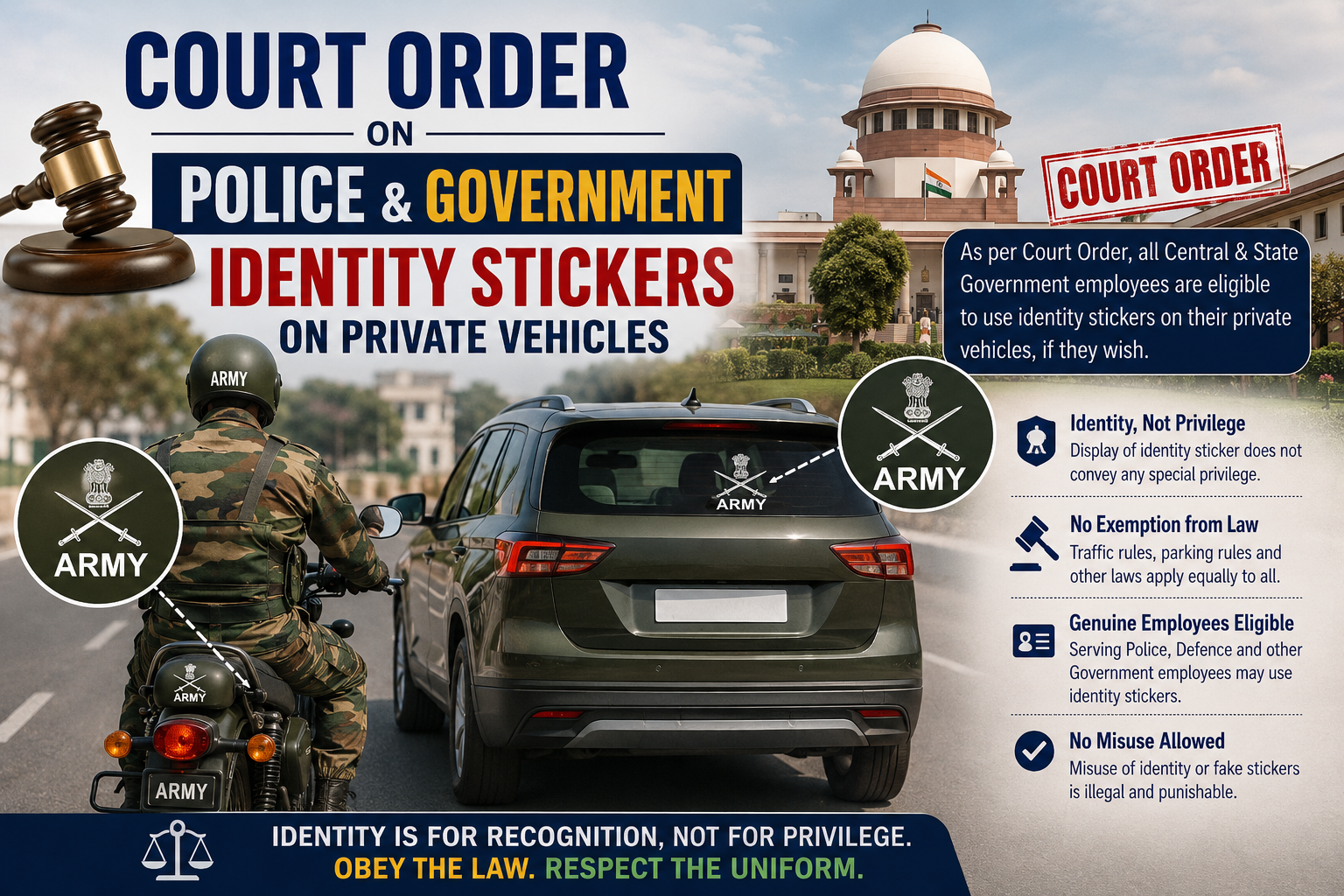
A recent news report from the Calcutta High Court has once again sparked a nationwide debate regarding the use of “Police”, “Army”, “Defence”, “Government”, or departmental stickers on private vehicles by serving personnel and government employees.
The issue is not limited to police personnel alone. Similar situations are frequently faced by serving members of the Indian Army, Navy, Air Force, CAPFs, and other Central and State Government employees. Many personnel display identity-related stickers or logos on their personal vehicles for recognition, security, or convenience purposes. However, misuse and unauthorized parking privileges have also led to legal scrutiny.
What Was the High Court Observation?
According to the report, the High Court observed that merely using a police sticker on a personal vehicle is not automatically illegal if the person genuinely belongs to the police department. The Court reportedly clarified that police personnel, as part of their official identity, may use such identification unless there is deliberate misuse or impersonation.
The case reportedly involved allegations that a police officer parked a personal vehicle illegally while using a police sticker to claim official privilege. The Court emphasized that the issue was not the sticker itself, but misuse of authority or attempting to treat a private vehicle as an official government vehicle.
The broader interpretation of this observation has relevance for Defence personnel and other government servants as well.
Similar Situation Faced by Defence Personnel
Across India, many serving Defence personnel use:
- Army stickers
- “Defence Personnel” labels
- Unit insignia
- Military formation stickers
- Canteen-related identity marks
- Veteran/Ex-Servicemen decals
on their personal vehicles.
In cantonment areas, military stations, naval bases, air force stations, and even civil areas near defence establishments, such stickers are commonly seen.
However, problems arise when:
- Local authorities assume the sticker gives immunity from traffic rules
- Individuals misuse stickers to avoid checking or challans
- Unauthorized civilians use fake defence/police stickers
- Security concerns emerge near sensitive installations
Because of these issues, several states and police departments have periodically conducted drives against unauthorized stickers and nameplates.
Are Government Employees Allowed to Use Identity Stickers?
The key legal principle is simple:
Identity Display Is Different from Claiming Official Privilege
If a serving Central or State Government employee genuinely belongs to a department, displaying identity-related symbols or stickers voluntarily on a personal vehicle may not itself amount to an offence. Hon’ble Calcutta High Court has also agreed with the statement.
This may include personnel from:
- Indian Army
- Indian Navy
- Indian Air Force
- Central Armed Police Forces (CAPF)
- Police Departments
- Intelligence Agencies
- State Government Services
- Central Government Ministries
However, the vehicle remains a private vehicle unless officially registered as a government vehicle.
That means:
- Traffic rules still apply
- Parking restrictions still apply
- Toll exemptions apply only where officially authorized
- No special immunity exists merely due to a sticker
Special Rules for Defence Personnel Regarding Army, Navy & Air Force Stickers
It is important to note that the Indian Army, Indian Navy, and Indian Air Force may have their own separate rules, security instructions, and administrative guidelines regarding the display of service-related stickers, formation signs, unit markings, or defence identity symbols on private vehicles.
Over the years, Defence authorities have issued various instructions and advisories concerning the use of “Army”, “Defence”, formation, or unit stickers on privately owned vehicles. These instructions were primarily aimed at:
- Preventing misuse of military identity
- Enhancing operational and security safety
- Avoiding impersonation by unauthorized persons
- Reducing security threats near military installations
- Discouraging unnecessary public display of sensitive unit details
- Preventing misuse of defence identity for VIP treatment or illegal advantages
Therefore, while a serving Army, Navy, or Air Force personnel may use authorized identification markings in certain situations, such use is always subject to the policies, standing orders, and instructions issued by the respective Defence authorities from time to time.
Army Stickers on Private Vehicles: Not an Automatic Right
The use of an Army sticker on a private vehicle does not automatically mean unrestricted permission. Defence personnel are expected to strictly comply with:
- Station Headquarters instructions
- Unit Standing Orders
- Military Police guidelines
- Security advisories issued by higher headquarters
- Ministry of Defence regulations
- Cantonment or military station access-control policies
In some military stations, locally authorized vehicle stickers are issued only for identification and entry management purposes. These are generally meant for controlled military areas and should not be misused outside authorized purposes.
Similarly, some formations have reportedly advised personnel to avoid excessive or prominent display of:
- Unit names
- Formation insignia
- Operational symbols
- Rank identifiers
- Sensitive military information
on personal vehicles due to security considerations.
Security Concerns Behind Such Restrictions
Defence authorities have increasingly become cautious because unauthorized use of Army stickers by civilians and criminals has been reported in several cases across India.
Fake defence stickers have allegedly been used for:
- Illegal access to restricted zones
- Avoiding police checks
- VIP-style road privileges
- Fraud and impersonation
- Criminal activities near sensitive areas
As a result, military and civil authorities periodically conduct verification drives against unauthorized or misleading defence markings on vehicles.
Important Point for Serving Personnel
Therefore, Defence personnel should clearly understand:
The use of Army, Navy, or Air Force stickers on private vehicles is not governed merely by public perception or general court observations. It is primarily subject to the internal rules, security instructions, and administrative orders issued by the respective Defence authorities.
Even where identity display is permitted, it does not provide exemption from:
- Traffic laws
- Parking regulations
- Civil police checking
- Toll rules (unless officially exempted)
- Public accountability
Best Practice for Defence Personnel
Serving personnel are advised to:
- Follow the latest unit/station instructions
- Use only officially permitted stickers or passes
- Avoid oversized or aggressive displays of military identity
- Never misuse service identity for personal benefit
- Remove unauthorized or outdated stickers when instructed
- Maintain operational security and personal safety at all times
Responsible use of service identity protects not only the image of the Armed Forces but also the security interests of the nation.
What Defence Personnel Must Remember
Personal Vehicle Is Not an Official Vehicle
Even if an Army officer, JCO, OR, sailor, air warrior, or police officer uses departmental identification on the vehicle, it does not convert the car into a government vehicle.
No Misuse of Authority
Using identity stickers to:
- escape challans,
- force parking access,
- bypass security,
- intimidate civilians,
- misuse beacon/light privileges,
can attract legal action.
Fake Stickers Are Illegal
Unauthorized use of:
- Army logos,
- Police insignia,
- Government emblems,
- “On Duty” plates,
- fake rank plates,
by civilians may amount to impersonation and other criminal offences.
Why Many Personnel Prefer Identity Stickers
Many serving personnel argue that such stickers help in:
- Quick identification during emergencies
- Easier entry into military or departmental areas
- Security recognition near installations
- Establishing identity during movement in sensitive zones
- Vehicle identification inside cantonments or police lines
In many defence stations, unit-based vehicle stickers are routinely issued for internal security management.
Supreme Court & Government Restrictions on VIP Culture
Over the years, Indian courts and governments have repeatedly discouraged “VIP culture” on roads.
This includes restrictions on:
- Unauthorized beacon lights
- Misleading government markings
- Improper use of official insignia
- False display of authority
Therefore, even genuine government employees are expected to use identity markings responsibly and within legal limits.
Practical Advice for Defence & Government Personnel
If you wish to use an identity sticker on your personal vehicle:
You Should:
- Use only genuine identification
- Follow departmental instructions
- Avoid oversized or misleading displays
- Obey all traffic and parking rules
- Remove unofficial “Government Duty” markings unless authorized
You Should Avoid:
- Fake logos or emblems
- Red/blue beacons without authorization
- “Govt of India” markings on private vehicles
- Misusing identity during traffic checking
- Using stickers to seek unlawful privilege
Conclusion
The recent High Court observation highlights an important distinction: displaying a departmental identity sticker and misusing official authority are two different things.
For Defence personnel, police personnel, and other government employees, identity-related stickers on private vehicles may not automatically be illegal when genuinely connected to their service identity. However, such display does not provide exemption from law, traffic regulations, or public accountability.
The real issue before courts is not the sticker itself — but whether someone is misusing government identity to obtain unlawful advantage.
Jai Hind 🇮🇳