

Many serving and retired members of the Indian Armed Forces are unaware that the Government of India has long recognized land concessions as a welfare measure for service personnel. Under directives issued by the Ministry of Defence (MoD), soldiers can apply for allotment of government wasteland for residential or agricultural purposes through the state administration.
Although the scheme has existed for decades, many eligible personnel face difficulties due to administrative delays, disputes with existing occupants, and lack of awareness about the application process. This article explains the legal authority, eligibility conditions, application procedure, and dispute resolution mechanisms related to wasteland allotment for service personnel.
Legal Authority Behind Wasteland Allotment
The foundation of wasteland allotment for Armed Forces personnel comes from a Government of India, Ministry of Defence letter dated 15 June 1964, addressed to all State Governments and Union Territory Administrations.
The letter directed state authorities to provide land concessions to Armed Forces personnel as a welfare measure. The policy was intended to assist service members in establishing agricultural activities and securing residential land after their military service.
Subsequently, another important communication was issued on 25 April 1967 by G.D. Chaudhary, Secretary, Ministry of Defence, highlighting several implementation issues and directing state authorities to resolve them promptly.
Who Is Eligible for Wasteland Allotment?
The guidelines discussed here primarily apply to general category service personnel, including:
Serving soldiers of the Indian Army
Sailors of the Indian Navy
Airmen of the Indian Air Force
Retired Armed Forces personnel (subject to state-specific rules)
These provisions are separate from special concessions available to:
Gallantry Award Winners
Disabled Soldiers
Battle Casualties
Veer Naris (War Widows)
Other Special Category Beneficiaries
Such categories often enjoy additional benefits under separate policies.
Types of Land That May Be Allotted
The concession generally relates to government-owned wasteland that can be utilized for:
1. Residential Purpose
Land allotted for constructing a house or establishing permanent residence.
2. Agricultural Purpose
Land allotted for cultivation, farming, horticulture, or related agricultural activities.
Historically, these two allotments have often been processed separately, creating administrative inconvenience for applicants.
Application Procedure for Wasteland Allotment
Service personnel seeking allotment of wasteland should follow the procedure outlined below.
Step 1: Submit an Application
The applicant should submit a formal application to the:
District Collector
District Magistrate
Deputy Commissioner
Relevant District Administration Authority
The application should clearly mention:
Service particulars
Rank and service details
Residential address
Purpose of allotment
Preference for residential or agricultural land
Step 2: Identify Available Wasteland
The process becomes significantly easier if the applicant can provide information about available wasteland. Useful details include:
Village name
Taluka/Tehsil
Survey number (if available)
Approximate area
Current status of land
Providing precise information helps the administration verify and process the request more efficiently.
Step 3: Verification by Authorities
The district administration typically conducts:
Land record verification
Revenue department inspection
Eligibility verification
Availability assessment
After verification, the proposal may be processed according to state government rules.
Step 4: Issue of Allotment Order
If approved, the competent authority issues an allotment order specifying:
Location of land
Area allotted
Conditions of use
Rights and obligations of the allottee
Major Problems Faced by Service Personnel
The Ministry of Defence observed several practical difficulties in implementing the land concession scheme.
1. Non-Permanent Allotments
One of the major concerns highlighted in the 1967 MoD communication was that some states were making allotments on a temporary rather than permanent basis. This created uncertainty regarding:
Ownership rights
Long-term cultivation
Development of residential property
Financial investment in the land
2. Separate Allotment of Residential and Agricultural Land
The Ministry noted that separate processing of:
Housing land & Agricultural land caused considerable inconvenience to service personnel. A more integrated approach was recommended to reduce hardship.
3. Existing Occupants Refusing to Vacate
Perhaps the most common dispute involved original cultivators or occupants refusing to vacate the allotted land. Such situations often resulted in:
Delayed possession
Legal disputes
Administrative complications
Financial loss to the allottee
How Are Land Disputes Resolved?
Recognizing these challenges, the Ministry of Defence issued clear instructions through its 1967 communication.
The key directive was:
“All disputes relating to wasteland allotment should be settled expeditiously.”
State governments and district administrations were instructed to:
Remove administrative delays
Resolve possession-related disputes
Ensure implementation of land concession policies
Facilitate timely transfer of land to eligible service personnel
Importance of Proper Documentation
Applicants should maintain copies of:
Service certificate
Discharge book (for veterans)
Pension documents (if retired)
Identity proof
Application acknowledgment
Correspondence with district authorities
Proper documentation can significantly strengthen a claimant’s case in the event of delays or disputes.
How to Improve the Chances of Successful Allotment
Service personnel can improve the efficiency of their application by:
Identifying Land Before Applying
Providing specific details of available wasteland reduces administrative workload.
Following Up Regularly
Periodic follow-up with district authorities helps keep the application active.
Coordinating with Revenue Authorities
Obtaining land record information from local revenue offices can support the request.
Maintaining Complete Records
A well-documented application often receives quicker consideration.
Key Takeaways
- Wasteland allotment for Armed Forces personnel is based on Ministry of Defence directives issued on 15 June 1964.
- Applications must generally be submitted through the District Administration.
- Providing precise details about available land can expedite processing.
- Common challenges include non-permanent allotments, separate residential/agricultural allotments, and disputes with existing cultivators.
- The Ministry of Defence directed state authorities in 1967 to resolve such disputes promptly.
- Proper documentation and regular follow-up remain essential for successful allotment.
Conclusion
The wasteland allotment policy reflects the Government’s commitment to supporting Armed Forces personnel beyond their active service years. While implementation challenges have existed for decades, the Ministry of Defence’s directives provide a clear framework for granting land concessions to eligible soldiers, sailors, and airmen.
Serving personnel and veterans should proactively engage with their district administration, maintain complete records, and understand their rights under the land concession policy. With proper awareness and timely action, eligible service members can benefit from this important welfare measure designed to support their long-term social and economic security.
- Subsidised Home Loan for Defence Personnel & Ex-Servicemen Families: 50% Interest Subsidy up to ₹1 Lakh
 Defence personnel families, war bereaved families and war-disabled ex-servicemen may… Read more: Subsidised Home Loan for Defence Personnel & Ex-Servicemen Families: 50% Interest Subsidy up to ₹1 Lakh
 - Ayodhya Ram Mandir Darshan Pass: Soldiers और Veterans के लिए नई Dedicated Facility
 Ayodhya Ram Mandir Darshan Pass for Soldiers: अयोध्या स्थित Shri… Read more: Ayodhya Ram Mandir Darshan Pass: Soldiers और Veterans के लिए नई Dedicated Facility
 - Sainik Rest Houses in India: Complete State-Wise List with Address and Phone Numbers
 A ready reference for serving soldiers and ex-servicemen travelling across… Read more: Sainik Rest Houses in India: Complete State-Wise List with Address and Phone Numbers
 - PMSS Renewal Application 2026: Complete Step-by-Step Guide for 2nd, 3rd & 4th Year Students
 The Prime Minister’s Scholarship Scheme (PMSS) is an important educational… Read more: PMSS Renewal Application 2026: Complete Step-by-Step Guide for 2nd, 3rd & 4th Year Students
 - Toll Tax Exemption for Military Personnel in India: Government Rules, 1901 Act and Why Veterans Are Not Exempt
 There is considerable confusion among serving defence personnel, ex-servicemen and… Read more: Toll Tax Exemption for Military Personnel in India: Government Rules, 1901 Act and Why Veterans Are Not Exempt
 - Sainik Rest Houses in India: State-Wise List, Address, Accommodation & Contact Details
 Sainik Rest Houses are an important welfare facility for Ex-Servicemen… Read more: Sainik Rest Houses in India: State-Wise List, Address, Accommodation & Contact Details
 - KSB Website Portal Service Restored on 4 September 2026: OTP Login Now Working, Ex-Servicemen Can Access Welfare Schemes
 KSB Website Portal Service Restored: The official website of the… Read more: KSB Website Portal Service Restored on 4 September 2026: OTP Login Now Working, Ex-Servicemen Can Access Welfare Schemes
 - Pension Adalat 2026: How to Resolve Pension Problems, File Grievances and Get Relief
 Pension Adalat 2026 is an important grievance-redressal mechanism for Central… Read more: Pension Adalat 2026: How to Resolve Pension Problems, File Grievances and Get Relief
 - Ayodhya Sainik Sadan & Ram mandir Visit Pass : Ex-Servicemen और Serving Defence Personnel के लिए – Booking, Charges और Ram Mandir Darshan की पूरी जानकारी
 अयोध्या में Ram Mandir के दर्शन के लिए जाने वाले… Read more: Ayodhya Sainik Sadan & Ram mandir Visit Pass : Ex-Servicemen और Serving Defence Personnel के लिए – Booking, Charges और Ram Mandir Darshan की पूरी जानकारी
 - AGIF Extended Insurance Scheme Update 2026: Veterans Can Get Up to ₹30 Lakh — Eligibility, Premium, Coverage, Claim Process & Documents
 AGIF Extended Insurance Scheme 2026 is an important post-retirement financial… Read more: AGIF Extended Insurance Scheme Update 2026: Veterans Can Get Up to ₹30 Lakh — Eligibility, Premium, Coverage, Claim Process & Documents
 - Kendriya Sainik Board OTP and Email Services Temporarily Down : Still Apply for MBBS & BDS Application
 Important Information on Kendriya Sainik Board (KSB) Ex-servicemen, widows, and… Read more: Kendriya Sainik Board OTP and Email Services Temporarily Down : Still Apply for MBBS & BDS Application
 - For Dependents of Exservicemen : Why They Must Know These Information and Pension Procedures Before It Is Too Late
 Veterans and Their Families Need to Prepare for the Future… Read more: For Dependents of Exservicemen : Why They Must Know These Information and Pension Procedures Before It Is Too Late
 - 18 Months DA Arrears for Central Government Employees: Reality, Facts, Supreme Court Judgments and Government Position
 The issue of 18-month Dearness Allowance (DA) and Dearness Relief… Read more: 18 Months DA Arrears for Central Government Employees: Reality, Facts, Supreme Court Judgments and Government Position
 - CKYC Digital ID कैसे Download करें ? Full Step-by-Step Guide 2026
 Introduction आजकल Bank Account, Mutual Fund, Insurance, Demat Account या… Read more: CKYC Digital ID कैसे Download करें ? Full Step-by-Step Guide 2026
 - How to Change an Old Discharge Book and Get a New Duplicate Discharge Book: Complete Guide for Ex-Servicemen
 How to Change an Old Discharge Book and Get a… Read more: How to Change an Old Discharge Book and Get a New Duplicate Discharge Book: Complete Guide for Ex-Servicemen
 - Family Medals for Next of Kin of Ex-Servicemen: Indian Army Guidelines on Wearing Family Medals
 The Indian Army has issued guidelines regarding the wearing of… Read more: Family Medals for Next of Kin of Ex-Servicemen: Indian Army Guidelines on Wearing Family Medals
 - Sainik Rest House Thiruvananthapuram: Room Rent, Facilities, Booking & Contact Details for Ex-Servicemen
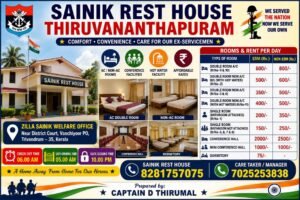 Sainik Rest House Thiruvananthapuram provides affordable accommodation facilities for Ex-Servicemen… Read more: Sainik Rest House Thiruvananthapuram: Room Rent, Facilities, Booking & Contact Details for Ex-Servicemen
 - Sainik Bhawan Bhubaneswar Re-Opens : Complete Booking Guide, Tariff & Address for Ex-Servicemen
 A budget-friendly, veteran-first accommodation option in Bhubaneswar is back in… Read more: Sainik Bhawan Bhubaneswar Re-Opens : Complete Booking Guide, Tariff & Address for Ex-Servicemen
 - PMSS Scholarship 2026: Mandatory Acknowledgement of Scholarship Amount After Merit Selection – Complete Guide for Students, Eligibility, Renewal & Payment Process
 PMSS Scholarship 2026: Students Must Acknowledge Scholarship Amount After Receiving… Read more: PMSS Scholarship 2026: Mandatory Acknowledgement of Scholarship Amount After Merit Selection – Complete Guide for Students, Eligibility, Renewal & Payment Process
 - Darshan Passes for Serving Soldiers & Veterans at Ayodhya Ram Temple: New Dedicated Facility Announced
 Ayodhya Ram Mandir Darshan Passes for Serving Soldiers & Veterans… Read more: Darshan Passes for Serving Soldiers & Veterans at Ayodhya Ram Temple: New Dedicated Facility Announced