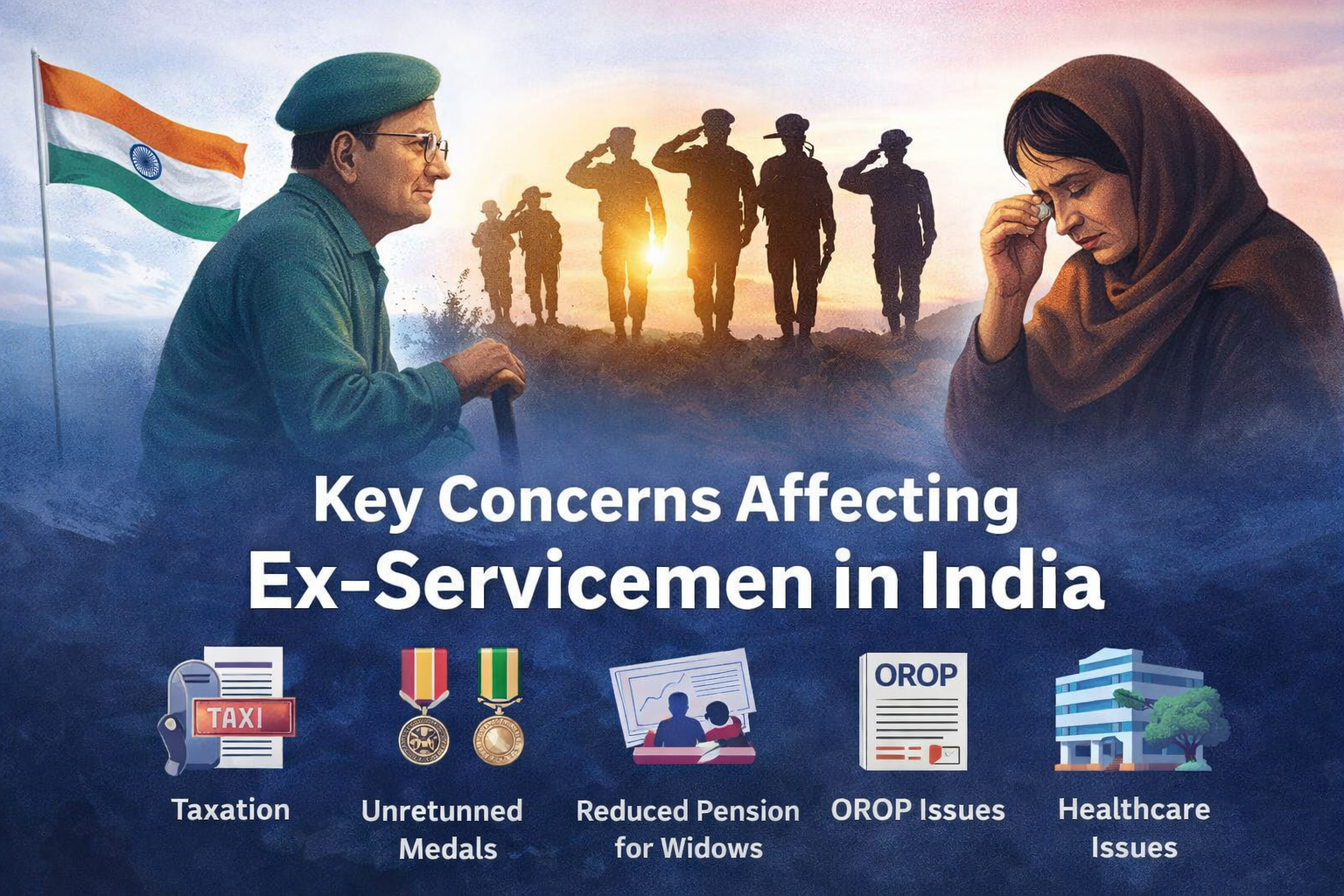
Dedicated service to nation by Ex-servicemen
Ex-servicemen form a crucial pillar of national security, having dedicated years—often decades—of their lives to safeguarding the country. However, several long-standing concerns related to pensions, welfare, recognition, and institutional support continue to affect this community. Addressing these issues is essential not only for justice and fairness but also for maintaining morale within the armed forces.
Taxation of Disability Pensions
Disability pensions have historically been exempt from income tax, recognizing the sacrifices made by injured soldiers. The imposition of tax on such pensions raises serious concerns:
- It undermines financial support for disabled veterans.
- The revenue generated is minimal compared to the negative impact on morale.
- It contradicts the principle of compensating those injured in service.
Recommendation: Restore full tax exemption on disability pensions.
Full Implementation of One Rank One Pension (OROP)
The concept of One Rank One Pension aims to ensure equal pensions for personnel retiring at the same rank and service length, regardless of retirement date.
Current issues include:
- Partial implementation leading to disparities.
- Gaps between past and current pensioners remain.
- Periodic revisions are not fully aligned.
Recommendation: Implement true OROP with automatic and consistent revisions.
Family Pension Disparities
There exists a disparity in how pensions are handled after the death of a service member:
- Widows receive reduced pensions (typically 60%).
- If the spouse predeceases the pensioner, no reduction applies.
- This creates an inequitable and discriminatory situation.
Recommendation: Ensure family pensions are equal to the full service pension to provide financial security to widows.
Honorary Rank Pension Issues
Personnel granted honorary ranks after retirement face inconsistencies:
- Those granted honorary ranks during service receive pension benefits.
- Those awarded honorary ranks post-retirement often do not.
Recommendation: Provide equal pension benefits to all honorary rank holders.
Return of Deposited Military Medals
A significant number of veterans had deposited their medals as a mark of protest in the past. Many of these medals have not yet been returned.
- Medals hold deep emotional and symbolic value.
- Families of deceased veterans are still awaiting their return.
- The delay reflects administrative inefficiency and insensitivity.
Recommendation: Expedite the return of all deposited medals to veterans or their families.
Concerns Regarding Pension Policy Framework (Terms of Reference)
Certain provisions in pension policy frameworks create ambiguity about pension entitlements:
- Pensions are part of service conditions, not welfare handouts.
- Any suggestion that undermines this principle creates uncertainty.
- Lack of clarity can lead to erosion of trust among defense personnel.
Recommendation: Ensure pension policies remain protected as a guaranteed right linked to service.
Pension Calculation Methodology for JCOs/ORs
Concerns exist regarding how pensions are calculated:
- Current system averages minimum and maximum scales.
- Earlier recommendations supported using maximum scales.
- This results in lower pensions for many personnel.
Recommendation: Adopt a more equitable pension calculation method based on the highest applicable scale.
Reservist Pension Implementation
Reservists face unresolved pension issues:
- A tribunal judgment recommended pensions not less than a fixed proportion of regular soldiers’ pensions.
- Implementation has been delayed for years.
- Legal uncertainties continue.
Recommendation: Fully implement tribunal rulings and ensure timely pension benefits for reservists.
Establishment of an Ex-Servicemen Commission
Unlike other social groups, ex-servicemen lack a dedicated statutory body:
- No centralized authority to address grievances.
- Lack of representation in policy-making.
- Fragmented support systems.
Recommendation: Establish a permanent Ex-Servicemen Commission for welfare, policy, and grievance redressal.
Unfilled Reserved Vacancies
A large number of vacancies reserved for veterans remain unfilled:
- Millions of positions exist across Group B, C, and D categories.
- Only a small fraction are actually filled.
- This defeats the purpose of reservation policies.
Recommendation: Ensure strict enforcement and monitoring of reservation quotas for veterans.
Funding Constraints in Military Healthcare
Healthcare schemes for veterans – ECHS is facing financial strain:
- Large pending dues to hospitals.
- Inadequate budget allocation.
- Difficulty in accessing quality treatment.
Recommendation: Increase funding and ensure timely payments to healthcare providers.
Revision of Healthcare Service Rates
Low reimbursement rates discourage hospitals from treating veterans:
- Many hospitals refuse admission.
- Veterans face denial of care or delays.
- Quality of service is impacted.
Recommendation: Align healthcare rates with prevailing market standards.
Defence Forces Covenant Framework
There is a growing demand for a formal covenant between the nation and its armed forces:
- Recognizes the sacrifices of personnel and their families.
- Ensures long-term welfare commitments.
- Aligns with models followed in other countries.
Recommendation: Enact a formal Defence Forces Covenant through legislation.
Concerns Over Military Recruitment Policy Changes
Recent recruitment reforms have raised concerns:
- Short-term service models may affect long-term force stability.
- Reduced career security for recruits.
- Potential impact on operational readiness.
Recommendation: Reassess recruitment policies to ensure sustainability, motivation, and long-term benefits.
Administrative Authority in Health Schemes
Changes in administrative powers within military healthcare systems have created issues:
- Reduced efficiency in decision-making.
- Delays in approvals and services.
- Increased bureaucratic hurdles.
Recommendation: Restore administrative autonomy for efficient healthcare management.
Conclusion
The concerns outlined above reflect systemic gaps in policy implementation, administrative efficiency, and welfare prioritization. Addressing these issues is not merely a matter of financial allocation—it is a matter of national responsibility.
Ensuring fairness, dignity, and security for ex-servicemen will:
- Strengthen trust in institutions,
- Improve morale within the armed forces,
- Reinforce the nation’s commitment to those who serve.
A comprehensive, timely, and empathetic approach is essential to resolve these long-standing concerns.