
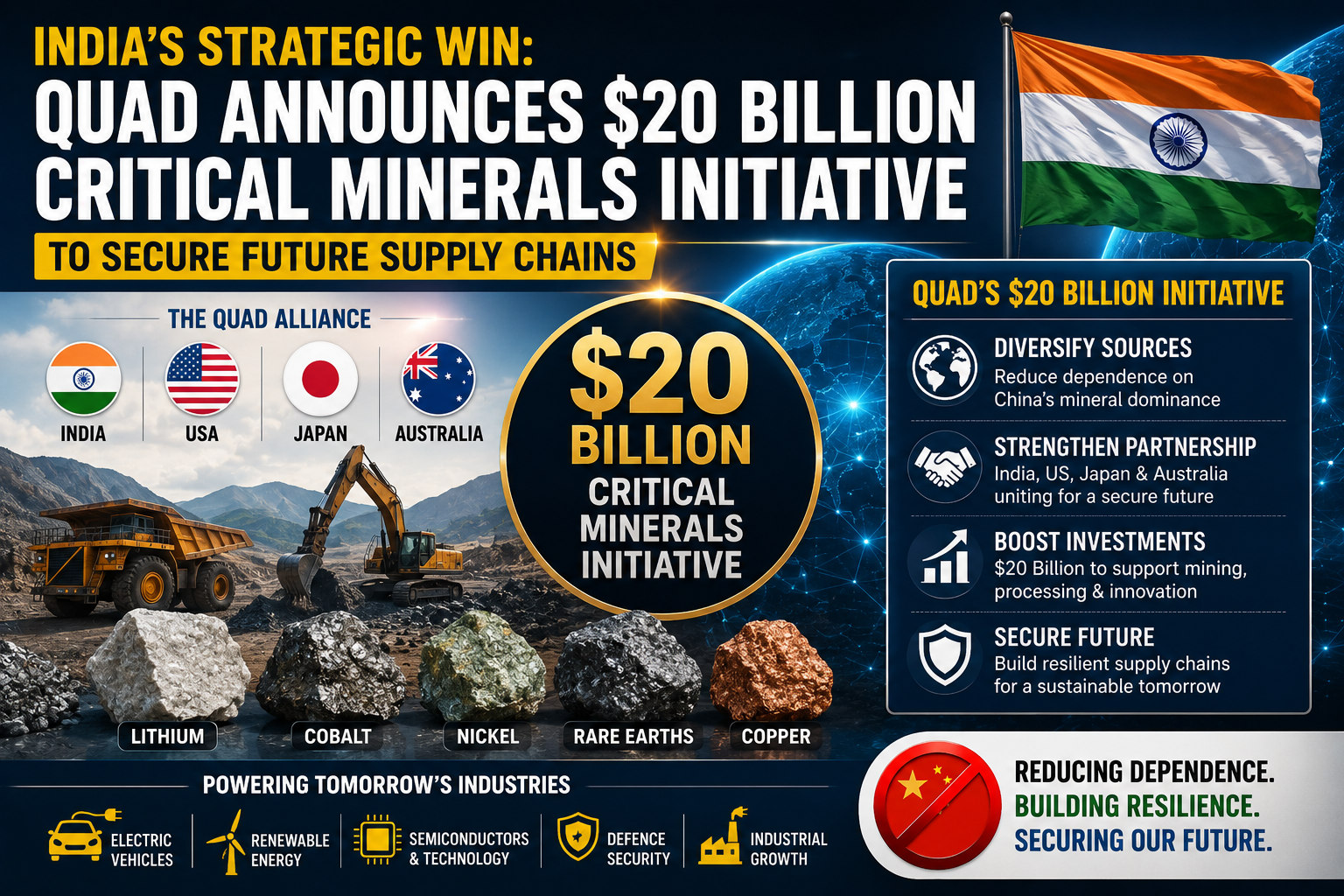
The Quadrilateral Security Dialogue (Quad)—comprising India, the United States, Japan, and Australia—has announced a landmark $20 billion Critical Minerals Initiative aimed at building secure and diversified supply chains for minerals essential to modern technologies. The move represents one of the most significant economic and strategic collaborations among the Quad nations and is widely viewed as an effort to reduce global dependence on China, which currently dominates the critical minerals sector.
The announcement was made during the Quad Foreign Ministers’ meeting, where leaders highlighted concerns over economic coercion, supply chain vulnerabilities, and the need for trusted partnerships in securing resources critical to future industries.
Why Critical Minerals Matter
Critical minerals such as lithium, cobalt, nickel, graphite, and rare earth elements are indispensable for a wide range of technologies, including:
- Electric vehicles (EVs)
- Renewable energy systems
- Battery storage technologies
- Semiconductors
- Aerospace and defense equipment
- Telecommunications infrastructure
- Artificial intelligence and advanced electronics
As countries accelerate their transition toward clean energy and digital economies, demand for these minerals is expected to grow exponentially over the coming decades.
The Challenge of China’s Dominance
China currently controls a significant share of the global critical minerals ecosystem, particularly in processing and refining capacities. While many minerals are mined in different parts of the world, a large proportion is ultimately processed in China before entering global supply chains.
This concentration has raised concerns among major economies regarding:
- Supply chain disruptions
- Geopolitical risks
- Export restrictions
- Economic coercion
- National security implications
The Quad nations believe that diversified and resilient supply chains are essential for long-term economic stability and technological leadership.
Key Features of the $20 Billion Initiative
The new Quad initiative aims to mobilize more than $20 billion in public and private sector investments across the critical minerals value chain.
Major Areas of Focus
1. Mining Development
The initiative will support exploration and development of new mining projects across partner countries and trusted jurisdictions.
2. Processing and Refining Capacity
A major objective is to reduce dependence on a single country for mineral processing by creating alternative refining hubs and industrial facilities.
3. Recycling and Circular Economy
The program emphasizes recycling of batteries and electronic waste to recover valuable minerals and reduce environmental impacts.
4. Supply Chain Security
The initiative seeks to establish trusted and transparent supply chains capable of withstanding geopolitical tensions and market disruptions.
5. Private Sector Participation
By encouraging investments from global mining companies, technology firms, and financial institutions, the Quad aims to accelerate project implementation and innovation.
What It Means for India
For India, the initiative presents a significant strategic and economic opportunity.
Strengthening National Critical Minerals Mission (NCMM)
The Quad initiative can complement India’s National Critical Minerals Mission (NCMM), which focuses on securing mineral resources essential for India’s energy transition and manufacturing ambitions.
Both initiatives share common objectives:
- Resource security
- Domestic processing capability
- Strategic partnerships
- Technology development
- Supply chain resilience
Boost to Employment
Large-scale investments in mining, processing, logistics, and manufacturing could generate thousands of direct and indirect jobs across India.
Technology Transfer and Skill Development
Collaboration with advanced economies such as the United States, Japan, and Australia may facilitate access to cutting-edge mining technologies, processing techniques, and environmental management practices.
Positioning India as a Global Hub
India has the potential to emerge as a major player in the global critical minerals ecosystem by leveraging its growing industrial base, skilled workforce, and strategic location.
Strategic Importance Beyond Economics
The initiative is not solely an economic program. It also reflects the growing strategic cooperation among Quad nations in addressing emerging global challenges.
By creating trusted supply chains and reducing concentration risks, the Quad seeks to enhance economic security while supporting clean energy goals and technological innovation.
The initiative also aligns with broader efforts to strengthen cooperation in areas such as semiconductors, cybersecurity, infrastructure development, and advanced manufacturing.
Challenges Ahead
Despite the ambitious vision, several challenges remain:
- Long project development timelines
- Environmental and regulatory approvals
- High capital requirements
- Global competition for mineral assets
- Infrastructure constraints
- Community and sustainability concerns
Success will depend on coordinated policies, sustained investment, and effective collaboration among governments and industry stakeholders.
Conclusion
The Quad’s $20 billion Critical Minerals Initiative marks a major step toward building secure, resilient, and diversified supply chains for resources that will power the technologies of the future. As global demand for critical minerals continues to rise, the partnership between India, the United States, Japan, and Australia could reshape the global minerals landscape and reduce excessive dependence on any single country.
For India, the initiative offers a unique opportunity to accelerate industrial growth, strengthen its National Critical Minerals Mission, attract investment, create jobs, and establish itself as a key player in the global clean energy and technology supply chain. As the world moves toward a greener and more digital future, critical minerals are set to become one of the defining strategic resources of the 21st century.