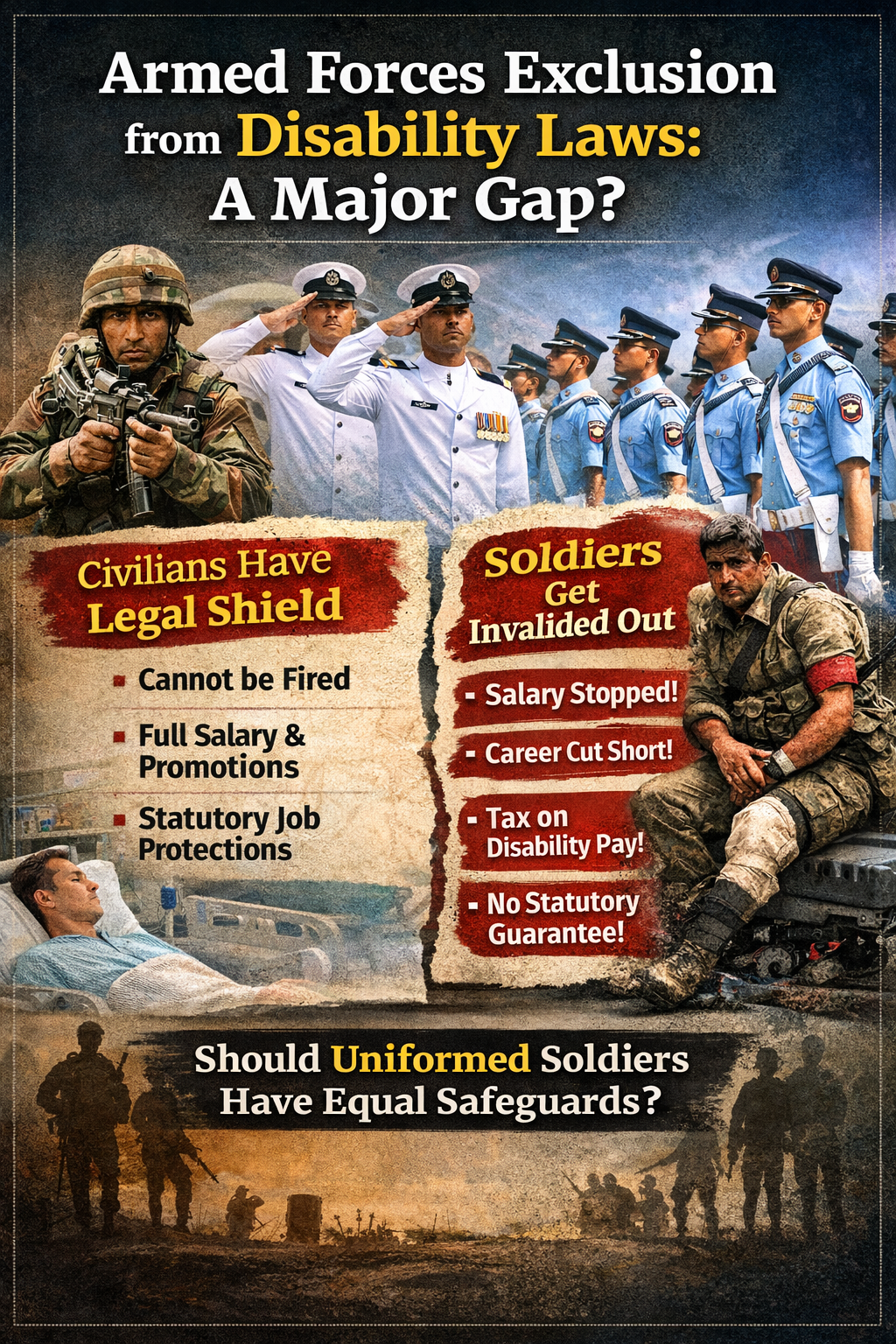
How many citizens are aware that combatant personnel of the Indian Army, Indian Navy, and Indian Air Force are excluded from the protections of India’s disability rights laws?
While India has progressively strengthened disability protections through the Persons with Disabilities Act, 1995 and later the Rights of Persons with Disabilities Act, 2016, a critical and lesser-known carve-out exists: combatant personnel of the Armed Forces are exempted.
This exemption has profound consequences — legal, financial, and moral.
The Legal Position: Who Is Protected — and Who Is Not?
The Ministry of Social Justice and Empowerment, through formal notifications, has exempted all categories of “combatant personnel” in the Armed Forces from the applicability of these Acts.
However:
- Civilian employees in military hospitals
- Staff in ordnance factories
- AFHQ Civil Service personnel
- Defence accounts and administrative staff
—all of whom are paid from the defence budget—are not excluded.
In effect:
Every civilian government employee enjoys statutory disability protection.
A uniformed soldier does not.
Section 20 of RPwD Act, 2016: The Civilian Shield
Under Section 20 of the Rights of Persons with Disabilities Act, 2016:
If a civilian government employee acquires a disability during service:
- They cannot be dismissed or reduced in rank.
- If unable to perform original duties, the department must create a supernumerary post.
- They continue to draw full salary.
- They receive promotions as per normal career progression.
- This protection continues until superannuation (typically age 60).
Even in cases of severe disability — including coma — the employment relationship legally continues.
This is not charity. It is statutory protection.
The Soldier’s Reality: Invalided Out
For a soldier, the pathway is starkly different.
If declared “unfit for further service” by an Invaliding Medical Board (IMB):
- The soldier is invalidated out of service.
- Employment ends.
- Salary stops.
- Career progression stops.
- Identity as a serving soldier ends.
The transition from uniform to civilian life may happen abruptly — not as a matter of misconduct, but because of injury sustained in service.
The Pension Question: A Changing Landscape
Historically, disability pensions for armed forces personnel were tax-exempt, a policy that dated back to the colonial era (1922). The exemption symbolised recognition of service-related sacrifice.
Recent fiscal changes, however, have altered the taxation landscape for certain disability components — creating further anxiety among veterans and serving personnel.
The broader issue is not merely about taxation. It is about parity of protection.
A Structural Paradox
Consider this contradiction:
- A civilian employee in a defence hospital is legally shielded by disability law.
- A soldier injured in active duty in the same campus is not.
Both are government servants.
Both draw salary from the Consolidated Fund of India.
Both pay income tax before their salary reaches their bank account.
Yet only one has a statutory employment guarantee in case of disability.
Why Were the Armed Forces Exempted?
Policy reasoning generally cites:
- Operational readiness
- Discipline and deployability requirements
- The unique nature of military service
Combat roles demand full medical fitness. Armies cannot function with large numbers of permanently non-deployable personnel.
This operational logic explains why exemption exists.
But it does not fully address what replaces the protection that civilians enjoy.
The Equity Debate
The debate is not about comparing hardship. It is about legal symmetry.
Questions that arise:
- Should there be an alternative statutory mechanism for armed forces personnel equivalent to Section 20 protections?
- Should supernumerary posts exist within non-combatant roles?
- Should long-term financial safeguards be strengthened for invalided personnel?
- Can disability benefits be insulated from future taxation changes?
These are not emotional questions — they are structural governance questions.
Taxpayer Argument: A Misconception
A common remark heard in public discourse:
“You are paid from taxpayers’ money.”
What is often forgotten:
- Soldiers are themselves taxpayers.
- Income tax is deducted at source.
- Invalided personnel continue to pay taxes on applicable income.
The relationship between soldier and state is not that of beneficiary and donor. It is that of citizen and constitutional institution.
International Comparisons (Brief Context)
In many democracies:
- Military personnel are excluded from certain civilian labour protections.
- However, dedicated veterans’ legislation provides robust compensatory frameworks.
- Rehabilitation, re-employment, and structured disability compensation are codified separately.
India has veteran welfare schemes — but not a statutory employment continuation guarantee equivalent to Section 20 of the RPwD Act.
The Moral Dimension
Military service carries inherent risk. The State recognises this through:
- Gallantry awards
- Disability pensions
- Ex-servicemen benefits
- Medical facilities
But the exclusion from disability law creates a perception gap.
A civilian employee has a legal shield.
A soldier has an administrative outcome.
The difference is subtle — but profound.
Not an Emotional Argument — A Policy Conversation
This issue need not be framed as civilian vs soldier.
Instead, it invites reflection:
- Can a nation strengthen protections for those who risk life and limb?
- Can operational readiness coexist with statutory dignity?
- Should Parliament consider a tailored disability protection framework for combatant personnel?
Public awareness on this subject remains limited. Yet it directly affects thousands of serving personnel and veterans each year.
Conclusion: Awareness Precedes Reform
The exclusion of combatant personnel from disability rights legislation is legally valid under notified exemptions. But legality does not close the policy debate.
A modern republic continuously reassesses its frameworks.
As India strengthens disability rights for civilians under the Rights of Persons with Disabilities Act, 2016, the question remains:
Should those who serve in uniform have an equivalent statutory safeguard — designed specifically for the military context?
Awareness is the first step.
Informed debate is the second.
Policy evolution is the third.
- 8th Pay Commission Latest Updates: सैलरी और पेंशन में कितनी होगी बढ़ोतरी?
- Social Value कैसे बढ़ाएं : समाज में Respect कमाने के 9 पावरफुल नियम
- Extended Army Group Insurance (AGIF) Death Benefit – Complete Guideline & Document List (2026)
- Policy Demands Concerning Ex-Servicemen Welfare in India : Require Immediate Attention
- Defence Quota in Education: Ministry of Defence Clarifies