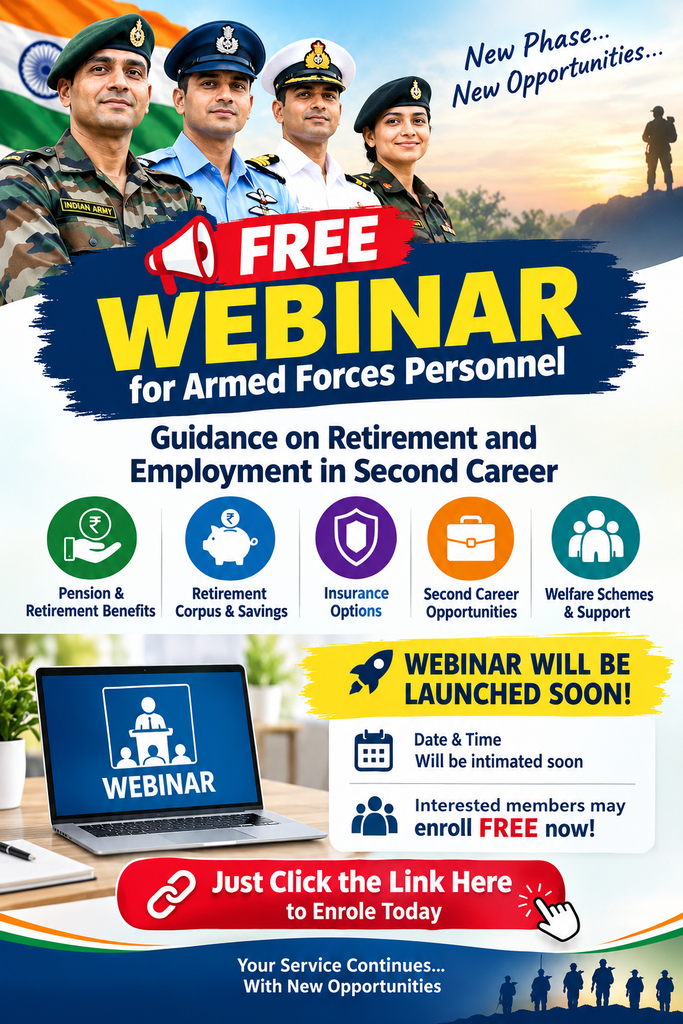
Retirement Planning for Indian Armed Forces Personnel | Age 35–55
Retirement from the Indian Army, Indian Navy or Indian Air Force is not simply the end of military service. It is the beginning of a new financial, professional and family phase.
For Armed Forces personnel, retirement planning involves much more than calculating pension. A successful transition requires advance planning for retirement corpus, pension, DSOPF/Provident Fund, insurance, leave encashment, healthcare, children’s education, dependants, investments, second career, skill development, government schemes, welfare benefits and succession planning.
The best time to start retirement planning is 10–15 years before retirement, not six months before discharge.
This guide is intended primarily for Armed Forces personnel in the 35–55 age group who want to build a financially secure and meaningful post-retirement life.
Important: Pension rules, welfare schemes, insurance benefits, investment taxation and eligibility conditions can change. Always verify the latest applicable Government/Service Headquarters orders before taking a financial or legal decision.
Why Retirement Planning Should Start at 35–55
Military personnel often retire considerably earlier than employees in many civilian professions. Consequently, retirement may mean another 20–30 years of active life.
Your retirement plan should therefore answer five important questions:
- How much regular income will I receive after retirement?
- How much retirement corpus will I need?
- How will I meet healthcare expenses?
- What will I do for the next 15–20 years professionally?
- What happens to my spouse and dependants if something happens to me?
A strong retirement plan combines guaranteed income + investment corpus + healthcare protection + insurance + second-career income + estate planning.
1. Calculate Your Retirement Corpus
Your retirement corpus is the amount of money you need to accumulate to maintain your desired lifestyle after retirement.
Do not calculate the corpus only on the basis of your current monthly expenses.
Consider:
- Household expenses
- Housing
- Children’s higher education
- Marriage expenses
- Medical expenses
- Parents’ support
- Travel
- Vehicle replacement
- Insurance premiums
- Emergency fund
- Inflation
- Major repairs
- Lifestyle expenses
- Support for dependants
A simple retirement calculation
Suppose your expected retirement household expenditure is ₹60,000 per month.
That is:
₹60,000 × 12 = ₹7.20 lakh per year
But if inflation continues, today’s ₹60,000 will not have the same purchasing power after 10–15 years.
Therefore, retirement planning should be based on future expenses rather than today’s expenses.
Build three separate funds
Instead of keeping everything in one investment bucket, consider creating:
Emergency Fund: 6–12 months of essential expenses
Retirement Corpus: Long-term investments intended for post-retirement life
Goal-Based Corpus: Money earmarked for children’s education, marriage, home purchase, etc.
This separation prevents you from prematurely using retirement money for short-term family requirements.
2. Understand Your Pension Properly
For most career Armed Forces personnel, pension is one of the most important components of retirement income.
Before retirement, understand:
- Service qualifying conditions
- Pensionable service
- Basic pension
- Dearness Relief
- Commutation
- Restoration of commuted pension
- Family pension
- Enhanced family pension where applicable
- Disability pension, where applicable
- Ordinary/Special/Family pension provisions
- OROP-related revisions where applicable
- Pension payment/disbursement arrangements
- PPO details
- Bank account linked to pension
The Department of Ex-Servicemen Welfare maintains the applicable pension regulations for the Army, Air Force and Navy, including the Entitlement Rules for Casualty Pensionary Awards to Armed Forces Personnel, 2023. (Department of Ex-servicemen Welfare)
Do not treat pension as your entire retirement plan
Pension provides an important income foundation, but retirement planning should also account for:
Pension + Retirement Corpus + Investment Income + Second-Career Income
This combination can significantly improve financial security.
3. DSOPF / Armed Forces Provident Fund
Your Provident Fund can become a substantial retirement asset.
Depending upon your Service and category, understand the applicable fund, contribution, accumulated balance, interest and final settlement procedure.
CGDA’s Defence Accounts documentation identifies Defence-side provident fund accounts including Defence Services Officers Provident Fund (DSOPF), Armed Forces Personnel Provident Fund (AFPP Fund) and Defence Savings Provident Fund (DSP Fund). (CGDA)
Before retirement, obtain and verify:
- Latest PF statement
- Contributions
- Interest credited
- Advances/withdrawals
- Outstanding recoveries
- Nomination
- Final settlement procedure
Important
Do not automatically spend your entire Provident Fund immediately after retirement.
A better approach is to divide the amount according to purpose:
Emergency reserve + safe investments + income-generating investments + long-term growth investments.
4. Insurance: AGIF, AFGIS and Naval Group Insurance
Insurance planning is particularly important because Armed Forces personnel may have substantial financial responsibilities when they retire.
Depending on the Service, relevant group insurance arrangements include:
- Army Group Insurance Fund (AGIF)
- Air Force Group Insurance Society (AFGIS)
- Naval Group Insurance arrangements
The exact benefits, contributions, maturity/survival benefits, post-retirement cover and eligibility depend on the applicable scheme and period of service.
Air Force example
AFGIS currently operates its Group Insurance Scheme for Air Warriors and also provides Air Veterans Insurance Cover (AVIC) for retired Air Warriors. The official AFGIS information states that AVIC evolved from the earlier Post Retirement Insurance Cover and provides post-retirement insurance protection subject to scheme conditions.
What you should check
Before retirement, verify:
- Insurance cover
- Survival benefit
- Retirement benefit
- Post-retirement insurance
- Nomination
- Premium/contribution
- Maturity conditions
- Death benefit
- Disability benefit
- Beneficiary details
Never assume that your in-service group insurance automatically provides the same cover after retirement.
5. Leave Encashment
Accumulated leave can create a significant retirement-time financial benefit.
Before retirement, check:
- Eligible accumulated leave
- Maximum encashable limit applicable to your Service/category
- Leave account
- Calculation method
- Tax treatment applicable to your circumstances
- Whether any outstanding leave-related adjustment exists
Do not rely on informal calculations. Obtain the final calculation from the competent Service/Record/Accounts authority.
Why leave encashment matters
For someone approaching retirement, leave encashment can become part of the initial retirement corpus and may be used for:
- Emergency fund
- Debt repayment
- Children’s education
- Medical reserve
- Investment
- Home modification
- Second-career setup
6. Mutual Funds for Long-Term Retirement Planning
Mutual funds can play an important role in long-term wealth creation, particularly for personnel who still have 10–20 years before retirement.
However, mutual funds are market-linked investments and are not guaranteed-return products.
Possible categories include:
- Equity mutual funds
- Hybrid funds
- Debt-oriented funds
- Index funds
- Short-duration debt funds
The right allocation depends on age, retirement date, risk tolerance, existing assets and future income requirements.
A key principle
The closer you move towards retirement, the more important capital preservation and income stability become.
Someone aged 40 with 15 years remaining may have a different asset allocation from someone aged 54 retiring within one or two years.
Avoid investing solely because a product has delivered high returns in the recent past.
7. Fixed Deposits and Safe Investments
FDs remain useful for retirement planning because they can provide:
- Predictable interest
- Capital stability
- Easy access
- Laddering opportunities
Instead of putting the entire corpus into one FD, consider creating an FD ladder with different maturity dates.
For example:
- 1-year FD
- 2-year FD
- 3-year FD
- 4-year FD
- 5-year FD
This can provide periodic liquidity.
However, compare post-tax returns rather than simply looking at the advertised interest rate.
8. Insurance After Retirement
Your military group insurance should not be your only insurance consideration.
Review:
Apart from Extended Insurance provided by AGIF/ Air Force Group Insurance / Naval Group Insurance, you might have neeed to get a personal insurance to protect your family. Keep the Extended insurance certificate safe and aware your family about the claim process.
Life Insurance
If your spouse/dependants would face financial difficulty without your income, evaluate whether additional life insurance is required.
Health Insurance
Even with ECHS eligibility, families should understand their healthcare coverage, exclusions and emergency requirements.
Personal Accident Insurance
This may be relevant depending on your post-retirement occupation and lifestyle.
Critical Illness
Evaluate carefully rather than buying multiple overlapping policies.
The objective is not to own many policies.
The objective is to have adequate financial protection.
9. ECHS: Plan Your Post-Retirement Healthcare
Healthcare planning is one of the most important parts of Armed Forces retirement planning.
ECHS provides healthcare support to eligible Armed Forces veterans and dependants. DESW identifies ECHS as the organisation responsible for healthcare needs of eligible veterans and dependants. (Department of Ex-servicemen Welfare)
Eligibility and dependent definitions should be checked against the latest ECHS rules.
DESW’s published FAQ, for example, lists eligible veterans drawing pension/disability pension and eligible family pensioners, and provides categories of dependants covered under the scheme. (Department of Ex-servicemen Welfare)
Before retirement
Make sure you understand:
- ECHS membership process
- Smart Card/beneficiary details
- Dependant documentation
- Polyclinic
- Empanelled hospitals
- Emergency treatment procedure
- Referral procedure
- Dependant eligibility
- Changes in dependant status
- Updating personal information
ECHS rules and empanelled healthcare arrangements are periodically updated; DESW’s current circular page shows recent revisions to applicable rates and hospital/diagnostic-centre empanelment during 2026.
10. CSD Benefits After Retirement
CSD is another important post-retirement facility for eligible Armed Forces veterans.
CSD officially states that its clientele includes serving personnel, families and ex-servicemen. It also provides AFD items such as cars, two-wheelers and household appliances subject to applicable entitlement and conditions. (CSD India)
Before making a major purchase through CSD, check the latest entitlement, frequency, price, taxation and eligibility rules.
Do not base a financial decision solely on an old CSD entitlement chart circulating on social media.
11. Dependants: Medical, Education and Welfare Facilities
Retirement planning is incomplete unless the family is included.
Create a separate list of benefits available to:
- Spouse
- Children
- Dependent parents, where applicable
- Children with disabilities
- Widow/family pensioners
- Other eligible dependants
KSB welfare programmes include financial assistance relating to education, disabled children, medical treatment, marriage, vocational training, penury and other areas, subject to scheme-specific eligibility. (Department of Ex-servicemen Welfare)
Eligibility can depend on factors such as:
- Rank
- Pensioner/non-pensioner status
- Age
- Income
- Disability
- Number of children
- Nature of assistance
- Date of application
Therefore, never assume that every welfare scheme applies to every veteran.
12. Nomination: One of the Most Ignored Retirement Tasks
Nomination should be reviewed before retirement and whenever there is a major family change.
Check nomination in:
- Provident Fund
- Insurance
- Bank accounts
- Investments
- Mutual funds
- Demat account
- Pension-related records
- Government schemes
- Insurance policies
- Other financial assets
Important distinction
A nominee and legal heir are not necessarily the same thing.
Nomination is an important operational mechanism for receiving assets, while succession may ultimately be governed by applicable law and estate documents.
13. Make a Proper Will
A Will is one of the most important documents for a retired Armed Forces family.
A Will can clearly communicate your wishes regarding:
- Bank deposits
- Investments
- Property
- Jewellery
- Vehicles
- Digital assets
- Insurance proceeds
- Personal belongings
- Business interests
Do not wait until old age to prepare a Will.
Review it after:
- Marriage
- Divorce
- Birth of a child
- Death of spouse/beneficiary
- Purchase of major property
- Major inheritance
- Change in family circumstances
For complex estates, consult a qualified legal professional.
14. Create a Retirement Document File
Maintain both a physical file and secure digital backup.
Important documents may include:
Service Documents
- Discharge Book
- PPO
- Service Record extracts where applicable
- Retirement/Release Order
- Identity documents
- ECHS documents
- CSD documents
- Medical documents
Financial Documents
- Bank details
- Pension account
- PF statement
- AGIF/AFGIS/NGIF documents
- Insurance policies
- Mutual fund statements
- Demat statement
- FD certificates
- Property documents
- Loan documents
Family Documents
- Marriage certificate
- Birth certificates
- Aadhaar/PAN
- Children’s educational documents
- Disability certificates where applicable
- Dependency-related documents
Legal Documents
- Will
- Property documents
- Nomination records
- Power of Attorney where required
Keep a simple “Family Financial Map” explaining where important documents and investments are located.
15. Senior Citizen Benefits
Retirement planning should also consider benefits that may become available at senior-citizen age.
These may include applicable:
- Banking concessions/products
- Government savings schemes
- Income-tax provisions
- Railway/travel provisions where applicable
- State-level welfare schemes
- Healthcare-related benefits
Rules change periodically, so verify the current conditions before making a financial decision.
16. Plan Your Second Career Before Retirement
One of the biggest mistakes made by retiring personnel is beginning the job search after retirement.
Start planning at least 2–3 years before retirement.
Your military experience can translate into civilian roles such as:
- Administration
- Security management
- Operations
- Logistics
- Supply chain
- Project management
- Training
- Facility management
- Risk management
- Compliance
- Quality control
- HR
- Corporate security
- Disaster management
- Aviation-related roles
- Infrastructure management
DGR’s mandate specifically includes pre- and post-retirement training, re-employment, self-employment and resettlement opportunities for Ex-Servicemen.
17. Government Jobs and Reservation
Eligible Ex-Servicemen may benefit from reservation, age relaxation or other concessions in specified Government recruitment, depending on the particular recruitment rules.
However, Ex-Servicemen eligibility is not identical for every recruitment.
Before applying, always read:
- Recruitment notification
- Ex-Servicemen definition
- Age relaxation provisions
- Reservation percentage
- Educational qualification
- Service requirements
- Discharge requirements
- Category certificate requirements
Never rely solely on WhatsApp messages claiming that a particular job is “reserved for ex-servicemen.”
18. Pre-Retirement Training
Pre-retirement training can significantly improve the transition from military service to civilian employment.
DGR provides resettlement training programmes for eligible personnel, with courses covering areas such as security, IT, management, hospitality, technical fields and other employability-oriented areas.
The exact eligibility and available courses change over time.
Therefore, personnel should check the current DGR training calendar rather than waiting until the final months of service.
19. Private Online Coaching and Skill Development
Government-sponsored training may not cover every emerging corporate skill.
Personnel aged 35–55 should consider acquiring civilian-recognised skills alongside military experience.
High-value areas may include:
- Advanced Excel
- Power BI
- SQL
- Data Analytics
- AI tools
- Digital Marketing
- Project Management
- Supply Chain Management
- Cybersecurity fundamentals
- Cloud fundamentals
- HR management
- Accounting and GST
- Corporate communication
- Business English
- Entrepreneurship
- Sales and business development
The objective is not to collect certificates.
The objective is to build job-ready skills + demonstrable projects + a civilian CV + LinkedIn profile + interview capability.
20. Post-Retirement Income Strategy
A successful retirement should ideally have more than one income source.
A possible framework is:
Pension → Stable Base Income
FD/Debt Investments → Stability & Liquidity
Mutual Funds/Long-Term Investments → Growth
Second Career → Active Income
Business/Self-Employment → Additional Income
Rental/Other Assets → Supplementary Income
Do not depend entirely on one source.
21. Register With KSB and ZSB
After retirement, staying connected with the official Ex-Servicemen welfare network is important.
The Kendriya Sainik Board (KSB) operates through Rajya Sainik Boards and Zila Sainik Boards. DESW describes KSB as the apex body responsible for policies and schemes relating to resettlement, welfare and rehabilitation of Ex-Servicemen and their dependants.
Make sure your registration/details with the appropriate Zila Sainik Board/Zila Sainik Welfare Office are updated.
Keep your:
- Address
- Mobile number
- Bank details
- Family details
- Pension information
updated whenever required.
22. Understand KSB Welfare Schemes
KSB welfare schemes can provide financial assistance in specific circumstances.
Current DESW listings include schemes relating to:
- Penury
- Education
- 100% disabled children
- Daughter’s marriage
- Widow remarriage
- Medical treatment
- Orphan children
- Vocational training for widows
- Serious disease treatment
- Mobility equipment
- Home-loan interest subsidy
Eligibility differs from scheme to scheme.
Important rule
Do not wait for a financial crisis before learning about welfare schemes.
Know the schemes while you are still serving.
23. Military Disability Pension: Know the Basic Framework
Personnel with service-related medical issues should understand their pensionary rights well before retirement.
Disability pension is governed by specific pension regulations, entitlement rules, medical assessment procedures and Government orders.
DESW currently publishes the Entitlement Rules for Casualty Pensionary Awards to Armed Forces Personnel, 2023, along with the Army, Air Force and Navy pension regulations.
The broad areas that may need examination include:
- Attributability
- Aggravation
- Invalidment
- Disability percentage
- Medical Board findings
- Service connection
- Rounding-off provisions where applicable
- Element of disability
- Impairment relief
- Invalid pension
- Service pension
- Family pension
- Review/appeal mechanisms
- Relevant pension regulations and Government orders
Keep your medical records
Personnel with a disability or service-related medical condition should carefully preserve:
- Medical Board proceedings
- Medical category documents
- Hospital records
- Specialist reports
- Disability assessment
- RMB/IMB documents where applicable
- Pension documents
- Relevant correspondence
Disability pension cases can be highly fact-specific. Therefore, avoid relying on generalized social-media advice.
24. Stay Connected With Veterans Organisations
Retirement does not mean isolation from the military community.
Veterans organisations can provide:
- Information sharing
- Welfare awareness
- Pension updates
- Legal/policy developments
- Medical information
- Community support
- Employment opportunities
- Family networking
You may join our WhatsApp Channel to stay updated : JOIN NOW
However, always distinguish between:
Official Government information
and
Opinions circulated by private organisations/social-media groups.
For pension and welfare decisions, verify information against official Government/Service sources.
25. The 5-Year Retirement Preparation Plan
Five Years Before Retirement
Start:
- Retirement corpus calculation
- Investment review
- Debt reduction
- Skill assessment
- Second-career research
- Children’s financial planning
- Insurance review
Three Years Before Retirement
Focus on:
- DGR training
- Professional certification
- Corporate networking
- CV preparation
- LinkedIn profile
- Investment restructuring
- Estate planning
Two Years Before Retirement
Review:
- Pension expectations
- PF
- Insurance
- Leave balance
- ECHS planning
- CSD documentation
- Nomination
- Will
- Family financial plan
One Year Before Retirement
Prepare:
- Retirement documentation
- Bank/pension arrangements
- Medical records
- ECHS documentation
- Investment allocation
- Second-career applications
- Emergency fund
Six Months Before Retirement
Conduct a final audit:
Pension ✓
PF ✓
Insurance ✓
Leave Encashment ✓
ECHS ✓
Nomination ✓
Will ✓
Documents ✓
Investment Plan ✓
Second Career ✓
Family Plan ✓
26. A Simple Retirement Portfolio Framework
Every person’s situation is different, but a conceptual retirement structure can look like this:
| Component | Purpose |
| Pension | Regular basic income |
| Emergency Fund | Immediate liquidity |
| FD/Debt | Stability |
| Mutual Funds | Long-term growth |
| Insurance | Risk protection |
| ECHS | Healthcare support |
| PF/Retirement Benefits | Retirement capital |
| Second Career | Active income |
| Business/Self Employment | Additional income |
| Property/Rent | Supplementary income |
The exact allocation should depend on age, risk tolerance, family responsibilities, retirement date, pension and existing assets.
27. The Retirement Planning Mistakes Armed Forces Personnel Should Avoid
Mistake 1: Waiting until retirement
Start at 35–40, not 55.
Mistake 2: Spending the entire retirement lump sum
A large lump sum can disappear surprisingly quickly.
Mistake 3: Ignoring inflation
₹50,000 today will not have the same purchasing power after 10–15 years.
Mistake 4: Depending only on pension
Pension is important, but diversification provides additional security.
Mistake 5: Ignoring spouse’s financial knowledge
Your spouse should know:
- Pension details
- Bank accounts
- Investments
- Insurance
- ECHS
- CSD
- Will
- Important contacts
Mistake 6: Not updating nominations
Old nominations can create unnecessary complications.
Mistake 7: Treating military skills as automatically transferable
Military experience is valuable, but the corporate world may require additional civilian certifications and skills.
Mistake 8: Ignoring health planning
Healthcare expenses can become one of the biggest retirement risks.
Mistake 9: Trusting investment agents blindly
Understand the product before investing.
Mistake 10: Losing contact with the welfare system
KSB, ZSB, DGR, ECHS and Service-specific organisations remain important after retirement.
28. Final Retirement Planning Checklist
Before retirement, ask yourself:
Financial
☐ Have I calculated my retirement corpus?
☐ Do I know my expected pension?
☐ Have I reviewed my DSOPF/PF balance?
☐ Have I checked leave encashment?
☐ Have I reduced unnecessary debt?
☐ Do I have an emergency fund?
☐ Have I reviewed my mutual funds and FDs?
Insurance
☐ Is my nomination updated?
☐ Have I checked AGIF/AFGIS/NGIF benefits?
☐ Do I have adequate post-retirement insurance?
☐ Does my family know the claim procedure?
Healthcare
☐ Is my ECHS documentation complete?
☐ Are dependants correctly recorded?
☐ Do I know my ECHS polyclinic and referral process?
☐ Are important medical records preserved?
Family
☐ Is my Will prepared?
☐ Are all nominations updated?
☐ Does my spouse know our financial position?
☐ Are important documents organised?
Career
☐ Have I identified my second career?
☐ Have I attended eligible DGR training?
☐ Have I acquired civilian-recognised skills?
☐ Have I prepared a civilian CV?
☐ Have I started networking?
Welfare
☐ Am I registered with the appropriate ZSB?
☐ Do I know applicable KSB welfare schemes?
☐ Do I know my ESM employment/reservation opportunities?
☐ Am I connected with credible veterans organisations?
Conclusion
Retirement planning for Indian Armed Forces personnel should begin long before the retirement date.
A successful transition is not created by a single investment or a large retirement lump sum. It is created by combining pension, retirement corpus, Provident Fund, insurance, healthcare, investments, family protection, succession planning, second-career preparation and welfare benefits.
For personnel between 35 and 55 years, the most valuable asset is time.
Starting early gives you more opportunities to:
Build wealth → Reduce debt → Develop skills → Protect your family → Plan your second career → Secure healthcare → Organise your estate → Build a financially independent retirement.
The Directorate General Resettlement specifically exists to support the transition of retiring personnel into civilian employment, self-employment and resettlement opportunities, while KSB and ZSBs provide the wider welfare framework for Ex-Servicemen and their dependants.
Your military retirement should not be treated as the end of your career. It should be planned as the beginning of your next chapter.
Frequently Asked Questions
At what age should an Armed Forces person start retirement planning?
Ideally, retirement planning should begin around 35–40 years of age, particularly when the likely retirement date is still 10–20 years away.
Is pension enough for retirement?
Pension can provide an important stable income, but it is generally prudent to create an additional retirement corpus and develop supplementary income sources.
Should I invest my retirement money entirely in FD?
Not necessarily. FD can provide stability and predictable interest, but a retirement portfolio may need a combination of liquidity, fixed-income assets and growth-oriented investments depending on the individual’s circumstances.
Is ECHS available to all military retirees?
Eligibility depends on the applicable ECHS rules and beneficiary category. Veterans and dependants should verify their specific eligibility and documentation requirements.
Can Ex-Servicemen get Government jobs after retirement?
Eligible Ex-Servicemen may benefit from specified reservation, age relaxation and other concessions depending on the recruitment rules of the particular post. Always read the current recruitment notification.
What does DGR do for retiring Armed Forces personnel?
DGR facilitates pre- and post-retirement training, resettlement, re-employment and self-employment opportunities for eligible Ex-Servicemen.
Why is a Will important for a retired Armed Forces family?
A Will helps communicate how a person’s assets should be distributed and can reduce uncertainty and family disputes. It should be prepared and reviewed according to applicable succession law.
What should I do with my DSOPF/PF retirement money?
Do not make an immediate spending decision. First calculate your emergency requirement, debt, future expenses, healthcare needs and income requirement, then decide how much should remain liquid, how much should be invested for growth and how much should generate regular income.