

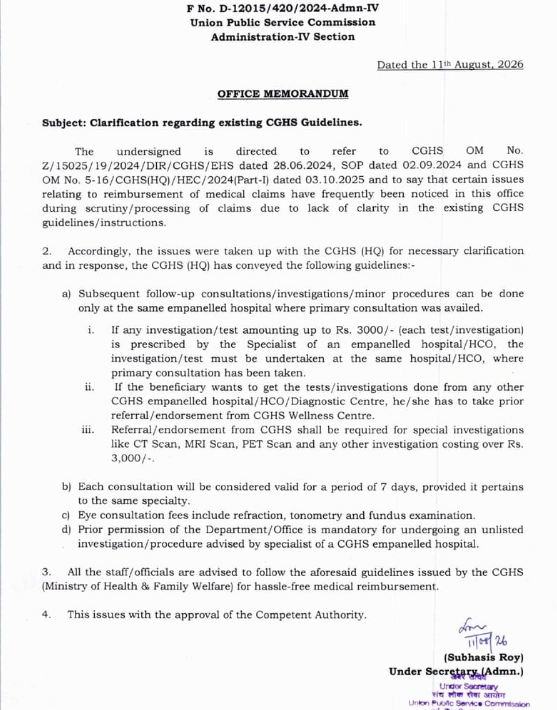
CGHS Guidelines Clarification 2026: The Union Public Service Commission (UPSC) has issued an Office Memorandum dated 11 August 2026 clarifying certain existing Central Government Health Scheme (CGHS) guidelines relating to medical consultation, diagnostic investigations, referrals and reimbursement of medical claims.
The clarification follows issues noticed during scrutiny and processing of medical reimbursement claims. The UPSC has referred to earlier CGHS Office Memoranda dated 28 June 2024 and 3 October 2025, along with the Standard Operating Procedure (SOP) dated 2 September 2024, and has communicated the clarifications received from CGHS Headquarters.
The latest clarification is particularly important for Central Government employees, CGHS beneficiaries, pensioners and other eligible beneficiaries, because failure to follow the specified procedure could create difficulties while claiming reimbursement.
CGHS Latest Clarification 2026: What Has Changed?
The latest communication does not introduce an entirely new CGHS medical reimbursement framework. Instead, it provides clarification on the existing guidelines where ambiguity had reportedly resulted in difficulties during scrutiny and processing of medical claims.
The four major areas clarified are:
- Subsequent consultation, investigation and minor procedures
- ₹3,000 limit for individual tests/investigations
- Validity of consultation for 7 days
- Eye consultation fees and services covered
- Prior permission for unlisted investigations/procedures
These provisions should be carefully understood by CGHS beneficiaries before undergoing investigations or seeking reimbursement.
1. Follow-Up Consultation and Investigations at the Empanelled Hospital
One of the most important clarifications concerns subsequent follow-up consultations, investigations and minor procedures.
According to the clarification, these can be undertaken at the empanelled hospital/HCO where the primary consultation was taken.
This means that if a CGHS beneficiary consults a specialist at a CGHS-empanelled hospital and that specialist prescribes a test or investigation, the beneficiary should generally undertake the investigation at em hospital/HCO.
This provision is important because beneficiaries may otherwise assume that they can freely shift the prescribed test to another empanelled hospital or diagnostic centre without any additional formalities.
2. What Is the ₹3,000 Test Rule Under CGHS?
The clarification specifically addresses investigations/tests costing up to ₹3,000 for each individual test or investigation.
If a specialist at a CGHS-empanelled hospital/HCO prescribes an investigation costing up to ₹3,000, the test is required to be undertaken at the hospital/HCO where the primary consultation was obtained.
Example
Suppose a CGHS beneficiary visits a specialist at an empanelled hospital and the doctor prescribes a diagnostic test costing ₹2,500.
Under the clarified guideline, the beneficiary should have that test performed at the empanelled hospital/HCO.
If the beneficiary instead wants to have the test performed at another CGHS-empanelled hospital or diagnostic centre, the prescribed procedure requires prior referral/endorsement from the CGHS Wellness Centre.
3. Can a CGHS Beneficiary Get the Test Done at Another Empanelled Hospital?
Yes, but the clarification specifies an important condition.
If a beneficiary wants to undergo a prescribed test or investigation at a different CGHS-empanelled hospital/HCO/Diagnostic Centre, the beneficiary has to obtain prior referral/endorsement from the CGHS Wellness Centre.
Therefore, beneficiaries should not assume that merely because both hospitals are CGHS empanelled, they can automatically shift the investigation from one hospital to another.
Important takeaway
Different CGHS empanelled hospital = prior CGHS referral/endorsement required.
This is particularly important for beneficiaries who prefer a particular diagnostic centre or hospital because of convenience, location or availability of specialised facilities.
4. CT Scan, MRI and PET Scan: Referral Requirement
The clarification specifically mentions major investigations such as:
- CT Scan
- MRI Scan
- PET Scan
- Other investigations costing more than ₹3,000
For such investigations, referral/endorsement from CGHS is required.
Therefore, beneficiaries should pay particular attention before undergoing high-value diagnostic investigations.
A specialist’s prescription alone should not be assumed to eliminate the requirement for CGHS referral/endorsement where the applicable rules require it.
5. CGHS Consultation Valid for 7 Days
Another important clarification concerns the validity of a consultation.
The latest clarification states that each consultation will be considered valid for 7 days, provided that it relates to the same specialty.
This provision can be particularly useful for beneficiaries requiring follow-up medical attention shortly after the original consultation.
Example
If a beneficiary consults a specialist on Monday, the consultation remains valid for the specified seven-day period, subject to the condition that the subsequent consultation relates to the specialty.
Beneficiaries should nevertheless maintain their consultation papers, prescriptions and supporting medical documents for reimbursement purposes.
6. CGHS Eye Consultation Fees: What Is Included?
The clarification also addresses eye consultation fees.
According to the CGHS clarification, eye consultation fees include:
- Refraction
- Tonometry
- Fundus examination
This clarification is important because these procedures may otherwise be treated separately during scrutiny of medical claims.
The latest instruction therefore provides clarity regarding what is included within the applicable eye consultation fee.
7. Prior Permission for Unlisted Investigation or Procedure
Another significant provision concerns unlisted investigations and procedures.
If a specialist at a CGHS-empanelled hospital recommends an unlisted investigation or procedure, prior permission of the concerned Department/Office is mandatory before undergoing it.
This is an important point for government employees because undergoing an unlisted procedure without obtaining the required permission could create complications during subsequent medical reimbursement processing.
Beneficiaries should therefore:
- Consult the specialist.
- Obtain the prescription/advice for the unlisted investigation or procedure.
- Check whether the procedure is listed under applicable CGHS provisions.
- Obtain the required prior permission from the Department/Office.
- Proceed with the investigation/procedure as per the applicable rules.
CGHS Medical Reimbursement: Why This Clarification Is Important
Medical reimbursement claims are normally scrutinised against applicable CGHS rules, empanelment conditions and prescribed procedures.
The UPSC communication states that certain issues were being noticed during the scrutiny and processing of medical claims due to lack of clarity in existing CGHS guidelines/instructions.
The clarification is therefore aimed at ensuring that officials follow a uniform procedure and that medical reimbursement claims can be processed without avoidable difficulties.
CGHS Guidelines 2026: Quick Reference Table
| Issue | Clarified Position |
| Follow-up consultation/investigation | At the empanelled hospital where primary consultation was taken |
| Test up to ₹3,000 | To be undertaken at the empanelled hospital/HCO |
| Test at another empanelled hospital | Prior CGHS referral/endorsement required |
| CT Scan | CGHS referral/endorsement required |
| MRI Scan | CGHS referral/endorsement required |
| PET Scan | CGHS referral/endorsement required |
| Other investigation above ₹3,000 | CGHS referral/endorsement required |
| Consultation validity | 7 days |
| Condition for 7-day validity | Same specialty |
| Eye consultation fee | Includes refraction, tonometry and fundus examination |
| Unlisted investigation/procedure | Prior Department/Office permission mandatory |
What CGHS Beneficiaries Should Do
CGHS beneficiaries should take a few precautions to avoid problems with medical reimbursement.
Keep the Original Prescription
Always retain the specialist’s prescription and investigation advice. It provides important documentary evidence of why the investigation was prescribed.
Check the Hospital’s CGHS Empanelment
Before undergoing treatment or investigation, beneficiaries should verify that the concerned hospital/HCO or diagnostic centre is covered under the applicable CGHS empanelment arrangement.
Obtain Referral When Required
For investigations at another empanelled hospital, as well as specified major investigations such as CT, MRI and PET scans, beneficiaries should obtain the required CGHS referral/endorsement.
Be Careful With Tests Above ₹3,000
The ₹3,000 threshold is specifically mentioned for each test/investigation. Beneficiaries should therefore carefully check the cost and applicable procedure before undergoing the investigation.
Obtain Prior Permission for Unlisted Procedures
If the specialist recommends an unlisted investigation/procedure, beneficiaries should obtain the required prior permission from their Department/Office before proceeding.
Does the New Clarification Change Existing CGHS Rules?
The wording of the communication is important.
It is titled “Clarification regarding existing CGHS Guidelines” and refers to earlier CGHS OMs and SOPs. The communication conveys clarifications received from CGHS Headquarters regarding issues that had arisen during processing of claims.
Therefore, beneficiaries should understand this as a clarification of existing procedures, rather than assuming that all CGHS medical reimbursement rules have been newly replaced.
Documents Referred to in the Latest Clarification
The UPSC Office Memorandum dated 11 August 2026 refers to the following CGHS documents:
- CGHS OM No. Z/15025/19/2024/DIR/CGHS/EHS dated 28 June 2024
- SOP dated 2 September 2024
- CGHS OM No. 5-16/CGHS(HQ)/HEC/2024 (Part-I) dated 3 October 2025
The latest clarification communicates the guidelines received from CGHS Headquarters in response to issues raised by the office.
Who Will Benefit From the Clarification?
The clarification is particularly relevant to:
- Central Government employees
- CGHS beneficiaries
- Central Government pensioners covered under CGHS
- Family pensioners covered under CGHS
- Eligible dependent family members
- Government offices processing medical reimbursement claims
- Administrative and Accounts sections dealing with medical claims
CGHS Medical Reimbursement 2026: Key Points to Remember
Before getting an investigation or procedure, remember these important points:
₹3,000 Test Rule:
A test/investigation costing up to ₹3,000 prescribed by an empanelled hospital specialist should be undertaken at the empanelled hospital/HCO.
Other Empanelled Hospital:
If the beneficiary wants to use another CGHS-empanelled hospital/diagnostic centre, prior CGHS referral/endorsement is required.
CT/MRI/PET:
Referral/endorsement is required for these special investigations.
7-Day Consultation:
Each consultation is valid for seven days when it concerns the same specialty.
Eye Consultation:
Refraction, tonometry and fundus examination are included in the eye consultation fee.
Unlisted Procedure:
Prior Department/Office permission is mandatory for an unlisted investigation or procedure advised by a specialist at a CGHS-empanelled hospital.
Conclusion
The CGHS Guidelines Clarification 2026 issued following the UPSC Office Memorandum dated 11 August 2026 provides important clarity on medical consultation, diagnostic investigations and reimbursement procedures.
The most significant points concern the 7-day validity of consultation, the ₹3,000 per-test rule, referral requirements for investigations at another empanelled facility, CT/MRI/PET investigations, inclusion of refraction/tonometry/fundus examination in eye consultation fees, and prior permission for unlisted investigations and procedures.
CGHS beneficiaries should carefully follow these requirements and retain all prescriptions, referral documents, bills and medical records. Following the prescribed procedure can help avoid unnecessary objections or delays during medical reimbursement claim processing.